Building safety depends on more than fire alarms, smoke detectors, sprinklers, and emergency exits. A comprehensive fire protection strategy also requires a dependable water supply capable of delivering the necessary flow and pressure when a fire occurs. At the center of many active fire protection systems is the fire pump, a critical piece of equipment designed to support water-based firefighting systems when the available water supply cannot provide sufficient pressure.
Fire pump reliability is essential because a fire emergency leaves little room for equipment failure. If a fire pump cannot start, fails to maintain the required pressure, or delivers insufficient water flow, the effectiveness of connected fire protection equipment may be compromised. The consequences can include delayed fire suppression, faster fire spread, increased property damage, and greater risks to occupants and emergency responders.
For building owners, facility managers, fire protection engineers, contractors, and project developers, understanding fire pump reliability is an important part of managing fire safety risks. From selecting suitable equipment to maintaining it throughout its service life, every decision can influence the performance of the overall fire protection system.
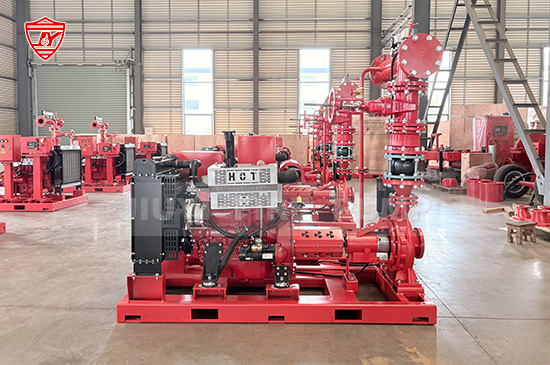
A reliable water supply is fundamental to effective firefighting. Municipal water systems, storage tanks, and other water sources may provide a sufficient volume of water but may not deliver the pressure required by a building's fire protection system.
Fire pumps are designed to increase water pressure and deliver the flow required by the system under specified operating conditions. Depending on the building's design, they may supply automatic sprinkler systems, standpipe systems, hydrants, and other approved firefighting equipment.
In high-rise buildings, industrial facilities, warehouses, and large commercial developments, maintaining the required water pressure can be particularly challenging. Water must reach the appropriate locations and operate within the hydraulic requirements established during system design.
A dependable fire pump helps the system achieve its intended performance when demand increases during a fire.
However, reliability does not depend on the pump alone. The complete installation must be designed to work as an integrated system, including the water source, suction piping, discharge piping, valves, controllers, power supply, and connected fire protection equipment.
If any critical component is incorrectly selected, installed, or maintained, overall system performance may suffer. For this reason, fire pump reliability should be considered a system-wide responsibility rather than simply a product specification.
When a fire starts, early suppression can help limit its development and reduce the potential for extensive damage. Fire pumps support this process by helping deliver the water required by the connected fire protection system.
If a fire pump fails to perform as intended, sprinklers or other water-based firefighting equipment may not receive the pressure or flow required by the design. This can reduce the effectiveness of fire suppression and allow the fire to spread more rapidly.
The potential consequences extend beyond the immediate fire area. Smoke can affect evacuation routes, heat can damage structural and electrical systems, and fire-related business interruptions can continue long after the incident has ended.
For commercial properties, industrial plants, and logistics facilities, prolonged downtime can create significant operational and financial challenges. In residential buildings, reliable fire protection equipment is also an important part of protecting occupants and supporting safe evacuation.
Although no single piece of equipment can eliminate fire risk, a properly designed and maintained fire pump system helps reduce the likelihood that inadequate water delivery will undermine the building's fire protection strategy.
Reliability therefore contributes to more than equipment availability. It supports the overall readiness of a building to respond to a fire emergency.
Different buildings have different fire protection requirements. The consequences of a fire pump failure can be particularly serious in facilities where fires may develop rapidly, where combustible materials are present, or where large areas require protection.
Several applications deserve particular attention.
High-rise buildings may require carefully engineered fire pump arrangements to overcome elevation-related pressure requirements and supply water to designated floors. Reliable operation is essential to ensuring that the system can meet its specified hydraulic demands.
Warehouses may contain large quantities of packaged goods, plastics, paper products, and other combustible materials. Depending on the storage configuration and commodity classification, fire protection systems may require substantial water flow. The fire pump must be selected to meet the project's calculated demand.
Oil refineries, chemical plants, and fuel storage facilities may face complex fire hazards involving flammable liquids, gases, and specialized industrial processes. Fire protection systems in these environments require careful engineering, suitable equipment, and dependable operation under the specified environmental and operating conditions.
Ports and terminals may handle cargo, fuels, containers, and industrial equipment across extensive operating areas. Reliable fire pump systems can support the fire protection infrastructure required for these facilities, subject to the applicable project design.
Buildings with large numbers of occupants require coordinated fire protection and emergency response arrangements. Reliable fire pumps help support water-based suppression systems that form part of the overall building safety strategy.
Across these applications, the correct pump configuration depends on the required flow, pressure, water source, system demand, environmental conditions, and applicable codes and standards.
Even a well-manufactured fire pump may perform poorly if it is incorrectly selected for the application. Choosing a reliable system begins with understanding the project's actual requirements.
The first consideration is the required flow rate and pressure. Fire protection engineers must establish the system demand through appropriate hydraulic calculations and determine the operating conditions under which the pump is expected to perform.
The selected pump should provide the required performance at the relevant operating point. Engineers should also review the manufacturer's pump curve to understand how flow, head, efficiency, and power requirements change across the operating range.
Other important selection factors include the following.
Water supply conditions: The suction source must provide adequate water availability and suitable suction conditions. Inadequate suction supply can affect pump performance and may contribute to cavitation or other operational problems.
Pump type: Common fire pump configurations include horizontal split-case pumps, end-suction pumps, and vertical turbine pumps. Each design has characteristics that make it suitable for different installation conditions and project requirements.
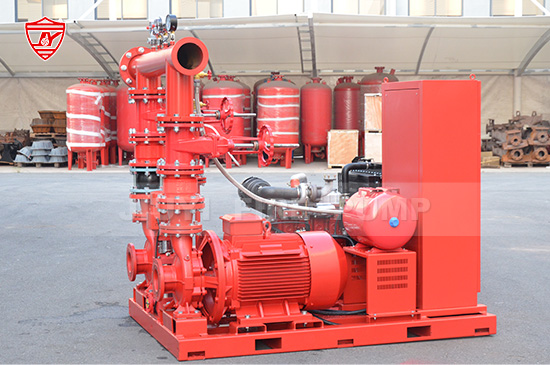
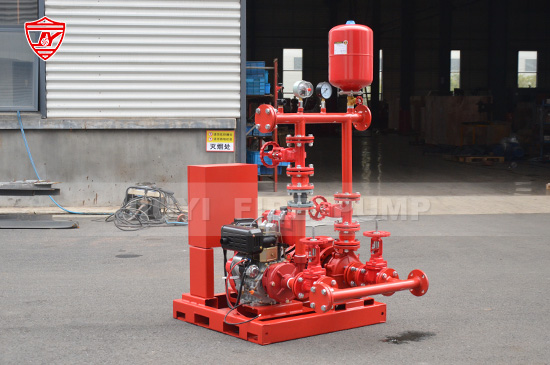
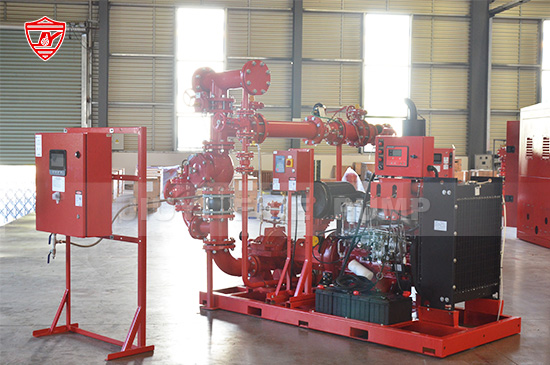
Driver selection: Electric motor-driven fire pumps are widely used where a suitable electrical supply is available. Diesel engine-driven fire pumps can provide an alternative drive arrangement when required by the project design. Some installations use multiple pump arrangements to meet system demand and applicable requirements.
Operating environment: Temperature, humidity, ventilation, flooding exposure, corrosive conditions, and available installation space can influence equipment selection and room design.
Applicable standards: Project specifications may require compliance with particular local codes, fire protection standards, certification requirements, and authority approvals. These must be verified for the intended application.
Selecting a pump based on the lowest purchase price alone can overlook important lifecycle and operational considerations. A more effective approach evaluates technical suitability, manufacturing quality, maintainability, testing, and long-term support.
Fire pump reliability begins long before equipment reaches the installation site. Design engineering, material selection, precision machining, assembly procedures, and quality control all influence the finished product.
A dependable manufacturing process should focus on consistency at every stage.
Pump hydraulic components must be manufactured to the required dimensions and quality specifications. Accurate machining and appropriate assembly practices help maintain intended clearances and mechanical alignment. These factors can influence hydraulic performance, vibration, wear, and operating stability.
The driver and pump must also be properly matched. For electric fire pumps, the motor must be suitable for the required load and operating conditions. For diesel engine-driven units, the engine, cooling arrangements, fuel system, exhaust configuration, and associated controls must be appropriate for the installation.
Controllers, pressure-sensing arrangements, and monitoring devices also require attention because they influence how the fire pump responds to system conditions.
A structured quality management process should include documented inspection procedures, component verification, assembly checks, and appropriate performance testing. Traceability of important manufacturing and test records can help manufacturers investigate issues and maintain consistent production quality.
For buyers and fire protection contractors, evaluating a manufacturer's production capabilities and quality assurance procedures provides useful insight into how reliability is managed before delivery.
A fire pump should not be judged by appearance or rated specifications alone. Appropriate testing provides evidence that the equipment performs according to its intended design and applicable acceptance criteria.
Factory performance testing can verify key operating characteristics, including flow rate, discharge pressure or head, speed, and power-related parameters, as applicable to the equipment and test procedure.
Testing across relevant operating points helps establish whether the pump's measured performance corresponds to the specified requirements. Additional inspections may be needed to evaluate mechanical condition, leakage, vibration, or other characteristics depending on the product and applicable standard.
For complete fire pump packages, testing and inspection may also cover the driver, controller, instrumentation, and other supplied components within the scope of the test.
Manufacturers serving projects with specific certification requirements should ensure that the applicable product models, configurations, and manufacturing facilities meet those requirements. Certification claims should be verified against the relevant listing or approval rather than assumed to apply to every product in a manufacturer's portfolio.
Factory testing is an important quality assurance measure, but it does not replace proper installation, commissioning, acceptance testing, or ongoing maintenance at the project site.
A pump that performs correctly at the factory must still be installed under suitable site conditions and integrated with the building's complete fire protection system.
Fire pumps may remain idle for extended periods, but they must be ready to operate when required. This makes preventive maintenance an essential part of fire protection management.
Without regular inspection and testing, issues such as battery deterioration, electrical faults, fuel problems, corrosion, blocked suction strainers, leaking seals, or controller alarms may remain undetected until an emergency occurs.
A maintenance program should follow the manufacturer's instructions, applicable fire protection standards, local regulations, and the requirements established by the authority having jurisdiction.
Depending on the installation, important activities may include:
Inspecting the pump room for suitable access, housekeeping, ventilation, and environmental conditions.
Checking valves, piping, gauges, and visible connections for damage, leakage, or abnormal conditions.
Verifying controller status, power availability, and relevant alarm indications.
Checking diesel engine fuel condition, starting batteries, cooling systems, and other engine-specific components.
Performing scheduled pump tests and recording operating conditions.
Investigating unusual vibration, noise, overheating, or deviations from established performance.
Documenting maintenance work, test results, corrective actions, and outstanding defects.
Testing frequency and procedures should be determined by the applicable requirements rather than by a generic schedule applied to every installation.
Records are particularly valuable because they establish a performance baseline. Comparing current readings with historical results can help identify developing problems before they lead to equipment failure.
Maintenance should also be carried out by appropriately qualified personnel, with suitable precautions to ensure that the building's fire protection coverage is managed during any impairment.
Choosing the right driver is another important part of developing a reliable fire pump system.
Electric fire pumps are commonly selected for buildings with a suitable electrical infrastructure. They can offer straightforward operation and may require less routine engine-specific maintenance than diesel-driven alternatives. However, their reliability depends on the suitability and availability of the electrical supply, controller, and associated equipment.
Diesel engine fire pumps can provide a different source of mechanical power and may be specified where required by the project's fire protection design. Their performance depends on factors such as engine condition, fuel availability, starting batteries, cooling, ventilation, and exhaust arrangements.
Neither configuration is automatically the best choice for every building. Selection must reflect the applicable standards, the reliability of available utilities, the building's risk profile, and the design requirements.
Some projects use electric and diesel fire pumps together as part of a coordinated arrangement. Such configurations can provide different operating options, but redundancy and resilience must be evaluated at the system level. Two pumps do not automatically provide effective backup if they share a vulnerable water source, have inadequate capacity, or depend on common components that can fail.
The objective is to design an arrangement that meets the project's required performance and reliability criteria.
Fire protection systems are subject to building codes, fire safety regulations, inspection requirements, and project-specific standards. The exact requirements vary by location, building type, system design, and authority having jurisdiction.
Reliable fire pump operation helps building owners maintain the intended performance of their fire protection systems. Inspection reports, test records, maintenance documentation, and corrective action records can also support compliance reviews and demonstrate that equipment is being managed appropriately.
However, purchasing a pump with a particular certification does not, by itself, establish that the complete installation complies with every applicable requirement. System design, installation, acceptance testing, maintenance, and documentation must all be addressed.
From a risk management perspective, reliability also helps reduce uncertainty. Facility managers can make better decisions when they understand equipment condition, know when testing was last completed, and have clear procedures for responding to faults or system impairments.
For buildings with complex fire protection arrangements, cooperation between owners, engineers, contractors, maintenance providers, and manufacturers is essential to maintaining this level of readiness.
Selecting a capable manufacturer is an important decision for contractors, distributors, engineering companies, and building developers. Beyond reviewing product specifications, buyers should evaluate the manufacturer's ability to deliver consistent quality and support the equipment throughout its intended service life.
Consider the following factors when comparing suppliers.
Engineering and product range: Determine whether the manufacturer can supply suitable pump types, flow rates, pressure ratings, drivers, and configurations for the project.
Manufacturing capability: Review machining, assembly, quality control, and other production processes relevant to the product being purchased.
Testing facilities: Ask how pump performance is verified and whether test documentation can be provided for the specified model and configuration.
Certification and standards: Confirm that any required listing, approval, or certification applies to the exact equipment being offered.
Technical documentation: Check the availability of performance curves, installation instructions, operation and maintenance manuals, and other required documentation.
Customization and package integration: For complex projects, determine whether the manufacturer can coordinate the pump, driver, controller, base frame, piping, and enclosure requirements within the agreed supply scope.
After-sales support: Consider access to spare parts, technical assistance, troubleshooting guidance, and maintenance information.
A reliable supplier should be able to explain how its equipment meets the project's technical requirements and provide documentation to support relevant claims.
These checks help buyers make informed decisions based on performance and long-term suitability rather than price alone.
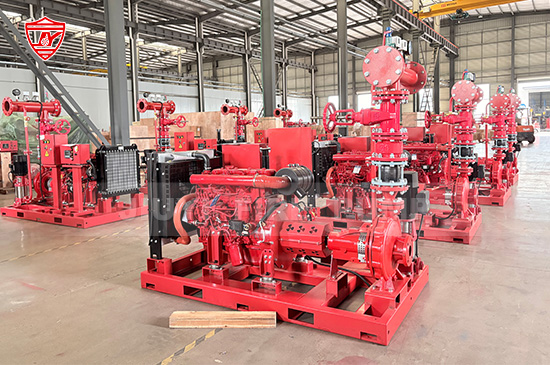
Fire pump reliability is a fundamental part of building safety because it helps ensure that water-based fire protection systems can deliver the required performance when a fire occurs. From high-rise buildings and shopping malls to warehouses, ports, and petrochemical facilities, dependable water delivery can make an important contribution to fire suppression and property protection.
Achieving reliability requires a comprehensive approach. Correct pump selection, sound engineering, manufacturing quality, factory testing, proper installation, commissioning, and preventive maintenance all contribute to system readiness.
Building owners and project teams should also recognize that a fire pump is only one component of a larger fire protection system. Its performance depends on suitable water supplies, correctly designed piping, reliable drivers and controls, and coordinated maintenance practices.
As a fire pump manufacturer, BETTER Technology Group understands the importance of combining engineering, manufacturing quality, and performance verification to meet the demands of fire protection projects. By working with qualified manufacturers and maintaining equipment according to applicable requirements, project stakeholders can help strengthen fire protection readiness and support safer buildings.