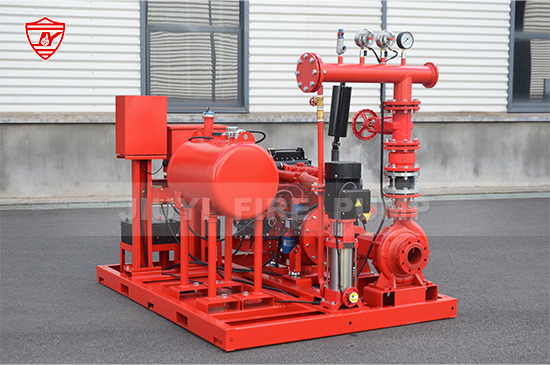
Fire pump efficiency is an important consideration when designing, selecting, installing, and maintaining a fire protection system. A properly selected and maintained fire pump can deliver the required flow and pressure while reducing unnecessary energy consumption, mechanical losses, and operating problems.
For fire safety applications, however, efficiency should never be considered separately from reliability and required fire protection performance. A fire pump must provide the hydraulic performance required by the system when demand occurs. The goal is not simply to reduce power consumption, but to achieve the required fire protection performance with an appropriately designed and efficiently operating pump system.
Improving fire pump efficiency starts with selecting the right pump, matching the pump to the system, minimizing hydraulic losses, maintaining the equipment correctly, and regularly verifying actual performance.
.jpg)
One of the most effective ways to improve fire pump efficiency is to select a pump that matches the actual hydraulic requirements of the fire protection system.
A pump that is significantly oversized may operate away from its most efficient operating region. An undersized pump, on the other hand, may not provide the required flow and pressure. Therefore, pump selection should begin with accurate system requirements, including required flow, pressure, static head, elevation difference, piping losses, and the characteristics of the water supply.
The pump performance curve should be carefully reviewed during selection. A typical pump curve shows the relationship between flow and head and may also provide information about efficiency, power requirements, speed, and other operating characteristics. The U.S. Department of Energy recommends selecting pumping systems with operating points reasonably close to the pump's best efficiency point, or BEP.
For a fire pump manufacturer, this means pump selection should not be based only on rated flow and rated pressure. The complete operating range should be considered.
The fire pump performance curve is one of the most important tools for evaluating pump performance.
The curve shows how the pump performs at different flow rates. By comparing the required system duty point with the pump curve, engineers can determine whether the selected pump can provide the required hydraulic performance.
Important points to evaluate include:
Operating too far away from the pump's preferred operating region can increase hydraulic losses, vibration, wear, and energy consumption. The U.S. Department of Energy notes that pump efficiency can vary considerably with operating conditions and that operating close to BEP can improve overall pumping performance.
For this reason, engineers should evaluate the complete pump curve rather than focusing on a single rated point.
Fire pump efficiency depends not only on the pump itself but also on the piping system connected to it.
Water flowing through pipes, fittings, valves, strainers, elbows, check valves, and other components experiences friction and pressure losses. If these losses are unnecessarily high, the pump must generate additional head to achieve the required pressure at the system.
A well-designed system should therefore minimize unnecessary resistance while maintaining all required fire protection functions.
Consider the following areas:
The U.S. Department of Energy identifies reducing pipe and valve pressure losses as one of the opportunities for improving pumping system efficiency. Better Buildings Solution Center
This is particularly important for large fire pump installations, where even relatively small hydraulic losses can have a significant effect on required pump power.
Good suction conditions are essential for reliable and efficient fire pump operation.
A pump requires adequate water supply at its suction connection. Poor suction conditions can result from excessive friction losses, unsuitable piping arrangements, insufficient water level, air entrainment, or other system problems.
Inadequate suction conditions can contribute to unstable operation and cavitation. Cavitation can damage pump components and reduce hydraulic performance.
For vertical turbine fire pumps, water level and available suction conditions are particularly important. Fire pump testing provisions address operating conditions at different flow points to verify that the pump is operating within appropriate design conditions.
During system design, the suction side should therefore receive the same level of engineering attention as the discharge side.
A fire pump should operate within the range for which it was selected and tested.
Operating conditions can change over the life of a fire protection system. Building modifications, changes in water supply, piping modifications, valve conditions, or additional fire protection zones can affect the actual system duty point.
If the pump is consistently operating far from its intended operating region, its efficiency and mechanical condition may be affected.
Regular performance testing provides an opportunity to compare actual operating conditions with the original pump performance.
During a fire pump acceptance or performance test, flow and operating conditions are measured at defined test points. NFPA documentation describes testing at minimum, rated, and peak loads and calls for operating conditions of the pump and driver to be measured.
These measurements provide valuable information about the condition of the fire pump system.
Even a highly efficient new fire pump can lose performance if it is not properly maintained.
Wear, corrosion, deposits, damaged components, incorrect clearances, bearing problems, seal issues, and other mechanical conditions can affect pump performance.
Maintenance should therefore include inspection of key components and verification of operating conditions according to the applicable standards, manufacturer recommendations, and site maintenance program.
The U.S. Department of Energy identifies restoring internal clearances and replacing worn components such as wear rings, impellers, pump bowls, and throat bushings as potential measures for restoring pumping system performance.
For fire pumps, maintenance is not simply an energy-efficiency activity. It is also part of maintaining the availability and reliability of the fire protection system.
The driver is another important part of overall fire pump efficiency.
Electric fire pumps rely on electric motors, while diesel fire pumps use diesel engines. The driver must provide sufficient power to operate the pump under the required conditions.
For electric systems, engineers should consider motor efficiency, voltage, electrical supply conditions, cable sizing, connections, and controller performance.
For diesel fire pumps, engine condition, cooling, fuel system condition, batteries, ventilation, exhaust arrangements, and operating environment can all influence performance.
It is also important to avoid evaluating pump efficiency separately from driver performance. The complete pump-and-driver assembly should be considered when evaluating system performance.
Control valves and other restrictions can introduce additional pressure losses into a pumping system.
In general pumping applications, throttling a pump to control flow can result in wasted energy. The Department of Energy lists control strategies, pressure-loss reduction, and proper pump selection among important opportunities for improving pumping system efficiency.
However, fire protection systems must always be designed and operated according to applicable fire protection standards and project requirements. Energy-saving measures should never compromise required fire flow, pressure, testing, or system reliability.
The correct approach is to optimize the complete hydraulic system during engineering and equipment selection rather than attempting to correct an inefficient system after installation.
Some fire protection systems use multiple pumps to meet specific flow and pressure requirements or to provide system redundancy.
When multiple pumps operate together, their combined performance needs to be evaluated carefully. Poorly matched pumps can create inefficient operating conditions or cause one pump to operate outside its preferred range.
The Department of Energy identifies optimization of parallel pumping systems as an area where pumping performance can be improved.
For fire protection applications, the selection and operation of multiple pumps must also satisfy the applicable fire protection requirements and the specific project design.
Proper hydraulic analysis can help determine how pumps should operate individually and together.
One of the most important steps in improving fire pump efficiency is to measure actual performance instead of relying only on theoretical calculations.
Important operating data can include:
Comparing measured results with the original pump performance curve can help identify changes in system performance.
For example, a reduction in available pressure at a given flow may indicate changes in the pump, piping, water supply, or other system components. A significant increase in power consumption may also indicate that the pump is operating under different conditions than originally intended.
Testing therefore serves both reliability and performance objectives.
Fire pump efficiency begins long before the equipment reaches the job site.
For manufacturers, hydraulic model development, casting quality, precision machining, impeller geometry, shaft alignment, assembly accuracy, and factory testing all influence pump performance.
A high-quality manufacturing process helps ensure that the finished pump performs consistently with its designed hydraulic characteristics.
Factory performance testing is particularly valuable because it allows manufacturers to verify flow, pressure, power, and other parameters under controlled conditions before shipment.
For projects with demanding performance requirements, working with a manufacturer that has dedicated pump testing capabilities can provide additional confidence in the selected equipment.
It is important to distinguish fire pump efficiency from simply reducing energy consumption.
A fire pump is a life-safety component. Its primary function is to provide the required water flow and pressure when the fire protection system demands it.
Therefore, an efficiency improvement is only appropriate when it maintains the required fire protection performance.
For example, reducing pump size without properly evaluating the system is not an efficiency improvement if the resulting pump cannot meet the required hydraulic demand. Similarly, changing operating conditions or controls simply to reduce energy consumption can be inappropriate if the change compromises required system performance.
The correct objective is optimized fire pump performance, combining hydraulic suitability, reliability, maintainability, and appropriate energy use.
A fire pump manufacturer can support project efficiency from the initial selection stage through manufacturing and testing.
This includes providing accurate performance curves, helping engineers select appropriate pump models, offering suitable pump configurations, maintaining consistent manufacturing quality, and conducting performance testing.
A manufacturer with experience in electric fire pumps, diesel fire pumps, jockey pumps, split case pumps, end suction pumps, and vertical turbine pumps can also help customers select equipment according to different project requirements.
The most effective approach is to evaluate the complete fire pump system rather than considering the pump as an isolated component.
.jpg)
Improving fire pump efficiency requires a system-level approach. Proper pump selection, accurate hydraulic analysis, good suction conditions, optimized piping, suitable drivers, regular maintenance, and performance testing all contribute to better pump performance.
The key is to ensure that the pump operates appropriately for the actual fire protection system while maintaining the required flow, pressure, reliability, and safety.
For fire pump projects, efficiency should therefore be considered from the beginning of the engineering process. A properly selected and professionally manufactured fire pump can provide dependable hydraulic performance while helping the overall system operate efficiently throughout its service life.

.jpg)