
Selecting a fire pump for a high-rise building requires more than simply choosing a pump with a high flow rate. A high-rise fire protection system must overcome significant elevation, friction losses, pressure requirements, and varying hydraulic demands while providing dependable performance during an emergency. The correct fire pump must be selected according to the building's fire protection design, hydraulic calculations, applicable codes and standards, and the characteristics of the water supply.
For building owners, fire protection engineers, contractors, and system integrators, understanding the key factors behind fire pump selection can help avoid undersized equipment, excessive pressure, inefficient operation, and costly changes during installation.
.jpg)
The first step in selecting a fire pump for a high-rise building is determining the required flow and pressure at the most demanding point of the fire protection system.
The required flow depends on the fire protection systems installed in the building. These may include automatic sprinklers, standpipes, hydrants, hose stations, or other water-based fire suppression systems.
Hydraulic calculations should determine the system demand rather than selecting a pump based only on the building's total floor area or height.
The key parameters normally include:
Required fire flow
Required residual pressure
Elevation difference
Pipe friction loss
Fittings and valve losses
Pressure losses through system components
Water source pressure
Required pressure at the remote or hydraulically most demanding area
The fire pump should provide sufficient flow at the required pressure under the design operating condition.
Elevation is one of the most important factors when selecting a high-rise building fire pump.
As water must be delivered to higher floors, additional pressure is required to overcome the static head created by elevation. In simple terms, the higher the water needs to travel, the greater the pressure required at the pump discharge.
Approximately 0.433 psi is required for every foot of elevation, or about 0.098 bar for every meter of elevation, before considering friction and other system losses.
For example, a building with a significant vertical distance between the pump and the highest protected area may require substantially more discharge pressure than a low-rise building with the same fire flow requirement.
However, simply increasing pump pressure is not always the correct solution. High-rise systems must also consider maximum allowable pressure for pipes, valves, sprinklers, hose connections, and other components.
This is why elevation should be evaluated together with the complete hydraulic calculation.
Fire pump flow is normally expressed in gallons per minute or liters per second, depending on the market and project specifications.
The required flow should be based on the calculated water demand of the fire protection system.
A common mistake is selecting a pump with a large flow capacity without verifying the actual system demand. An oversized pump can create unnecessary pressure, affect system components, increase energy consumption, and make system control more complicated.
On the other hand, an undersized pump may fail to provide sufficient water to the hydraulically remote area during a fire.
When selecting the pump, engineers should compare the required system demand with the pump's certified performance curve. The pump should be able to deliver the required flow at the required pressure under the specified operating conditions.
Flow alone cannot determine whether a fire pump is suitable for a high-rise building.
The pump must also generate enough pressure to overcome:
Elevation losses
Pipe friction losses
Fitting and valve losses
Equipment losses
Required residual pressure at the design point
The basic relationship can be considered as:
Required pump pressure = elevation pressure + friction losses + system component losses + required residual pressure − available inlet pressure
This provides a useful starting point for understanding fire pump selection.
The actual calculation should be performed according to the project's hydraulic design and applicable fire protection requirements.
For high-rise buildings, pressure management becomes particularly important because lower floors can experience considerably higher pressures than upper floors. System designers may therefore need pressure-reducing devices, pressure zones, multiple pump arrangements, or other design solutions depending on the building configuration.
Very tall buildings may require multiple pressure zones rather than supplying the entire building from a single pressure level.
A pressure-zone system divides the building into sections so that each section can operate within an appropriate pressure range.
Depending on the building design, solutions may include:
Multiple fire pump systems
Intermediate water storage tanks
Pressure-reducing devices
Separate risers
Zoned standpipe systems
Transfer pumps or booster pumps
Dedicated fire protection equipment for different building sections
The correct arrangement depends on building height, hydraulic calculations, available water supply, local regulations, and the overall fire protection design.
For extremely tall buildings, selecting a pump without considering pressure zoning can result in excessive pressure at lower elevations or insufficient pressure at upper floors.
The pump type should match the water source, required flow and pressure, installation conditions, and project requirements.
Common fire pump types used in high-rise applications include horizontal split-case pumps, end suction pumps, vertical turbine pumps, and other approved configurations.
Horizontal split-case pumps are widely used for larger fire protection applications. Their design can provide high flow capacity and convenient maintenance access.
They can be suitable where sufficient mechanical room space and an appropriate water supply arrangement are available.
End suction pumps are commonly used for applications with relatively compact installation requirements.
They may be suitable for certain building fire protection systems where the required flow and pressure fall within the pump's performance range.
A vertical turbine fire pump can be particularly important when the available water source is below the pump installation level or when the system requires a pump capable of drawing water from a tank, reservoir, or other below-grade source.
For high-rise and large commercial projects, the available water source should therefore be considered before deciding on the pump configuration.
The fire pump driver is another critical selection factor.
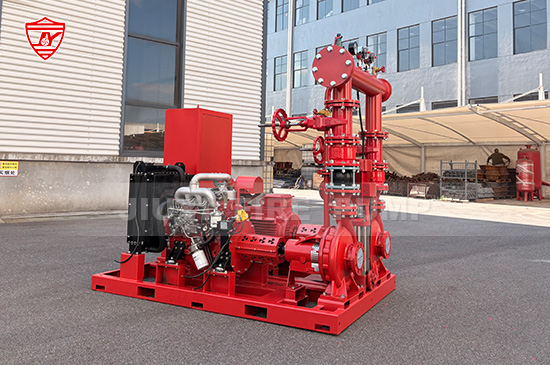
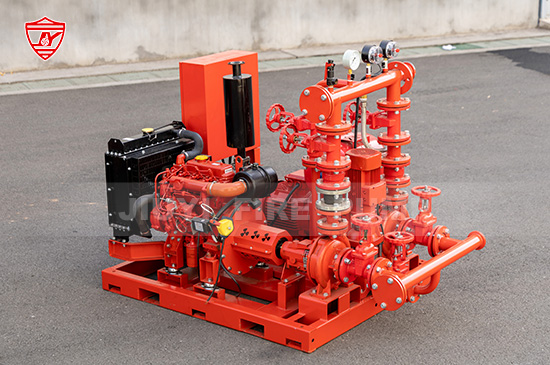
Electric motors are commonly used where a reliable electrical supply is available. Diesel engines can provide an independent power source and may be required or preferred depending on the project design and applicable requirements.
For critical fire protection systems, the reliability of the power supply should be evaluated together with the fire pump arrangement.
An electric fire pump system may include a dedicated fire pump controller and an appropriate electrical supply arrangement. A diesel fire pump system requires additional considerations such as fuel storage, ventilation, exhaust, batteries, cooling, and engine operating conditions.
Some projects use combinations of electric and diesel-driven fire pumps to provide redundancy and support system reliability.
A jockey pump is a small pressure-maintenance pump designed to compensate for minor pressure losses and maintain the fire protection system at its normal pressure.
It is not intended to provide the main fire flow required during a fire.
Correct jockey pump selection is important because an improperly sized jockey pump can interfere with the operation of the main fire pump. If the jockey pump is too large, it may delay the start of the main fire pump when a genuine water demand occurs.
The jockey pump should therefore be selected as part of the complete fire pump system rather than treated as an independent piece of equipment.
A pump nameplate rating alone does not provide enough information for proper selection.
Engineers should review the complete performance curve and compare it with the system demand.
Important points include:
Rated flow
Rated pressure
Shutoff pressure
Pressure at rated flow
Pressure at higher flow conditions
Motor or engine power requirements
Operating speed
The selected pump should provide appropriate performance across the expected operating range.
For example, a pump rated at a particular flow should not be evaluated only at that single point. Its performance at shutoff and at higher flow conditions should also be considered in relation to the applicable fire protection requirements.
For fire protection equipment, certification and compliance are important parts of the selection process.
Depending on the project location and specification, the fire pump may need to comply with recognized fire protection standards and certification requirements.
UL Listed and FM Approved equipment may be specified for certain projects. Other projects may follow different national or regional requirements.
Before purchasing a fire pump, the project team should confirm:
Required certification
Applicable fire protection standards
Local authority requirements
Project specifications
Required testing procedures
Required documentation
Certification scope for the specific pump model and configuration
Certification should be verified for the actual equipment being supplied rather than assumed based only on the manufacturer's general product range.
High-rise buildings often have limited mechanical room space, making physical installation an important consideration.
Before finalizing the pump selection, check the available space for:
Pump and driver
Controller
Piping
Valves
Test equipment
Ventilation
Exhaust system for diesel engines
Maintenance access
Removal and replacement of components
Maintenance access should be considered from the beginning of the design. A pump may meet the hydraulic requirements but still create practical problems if technicians cannot safely access critical components.
For large fire pumps, equipment layout should also allow sufficient space for inspection, testing, servicing, and eventual replacement.
A fire pump is emergency equipment. Its purpose is to provide water when the building's fire protection system needs it most.
For high-rise buildings, reliability should therefore be considered throughout the entire system.
Important factors include:
Reliable water supply
Reliable electrical power
Diesel backup where required
Appropriate controller selection
Proper pump room conditions
Regular inspection and testing
Preventive maintenance
Correct commissioning
Availability of replacement components
Where project requirements call for multiple pumps, the complete system should be evaluated as an integrated arrangement rather than selecting each pump independently.
Fire pump selection is most effective when the manufacturer is involved early in the project.
The manufacturer can review the required flow, pressure, pump type, driver, controller, installation conditions, and certification requirements before equipment is finalized.
Providing accurate project information is essential. A typical technical inquiry should include the required flow rate, required pressure, water source, elevation, power supply, installation location, applicable certification, and project standards.
The more complete the information, the easier it is to select an appropriate fire pump configuration.
.jpg)
Selecting a fire pump for a high-rise building is a hydraulic and engineering decision, not simply a matter of choosing a pump with the largest flow or highest pressure.
The selection process should begin with the required system demand and then consider elevation, friction losses, residual pressure, water supply, pressure zones, pump type, driver, jockey pump, performance curve, certification, installation conditions, and long-term maintenance.
A properly selected high-rise building fire pump should work as part of the complete fire protection system and provide the required flow and pressure when the system demands it.
For fire pump manufacturers, the goal is not simply to supply a pump. It is to provide equipment that matches the project's hydraulic requirements, operating conditions, applicable standards, and installation environment. Careful selection at the design stage can help contractors and building owners achieve a reliable and maintainable fire protection system for high-rise applications.
.jpg)