Warehouses present unique challenges for fire protection systems. Large storage areas, high ceilings, combustible materials, rack storage, narrow aisles, and changing inventory conditions can all affect the water demand of a fire protection system. Selecting the right fire pump is therefore an important part of designing a reliable warehouse fire protection solution.
A fire pump must provide the required water flow at the pressure needed by the sprinkler system and other fire protection equipment. Choosing a pump based only on horsepower, pipe size, or a simple flow rating can result in an improperly designed system.
So, how do you select a fire pump for a warehouse?
The process should begin with the fire protection system requirements and hydraulic demand. From there, engineers can determine the required flow, pressure, pump type, driver, controller, and supporting equipment.
This guide explains the major factors to consider when selecting a fire pump for warehouses.
.jpg)
The first step is to understand the warehouse itself.
Not every warehouse has the same fire risk. A small warehouse storing non-combustible products will have different requirements from a high-piled storage facility containing plastics, packaging materials, chemicals, or other combustible goods.
Important factors include:
Warehouse size and building layout
Ceiling height
Storage height
Storage configuration
Rack or pallet storage
Commodity classification
Type and quantity of stored materials
Sprinkler type
Sprinkler spacing
Number of sprinkler zones
Hose stream requirements
Available water supply
Required fire protection equipment
The fire pump should be selected according to the complete fire protection system rather than as an independent piece of equipment.
For projects designed under applicable fire protection standards, the hydraulic calculation and design requirements should establish the required water flow and pressure before the pump is selected.
Flow is one of the most important parameters in fire pump selection.
Fire pump flow is commonly expressed in gallons per minute (GPM) or liters per minute (L/min). The required flow depends on the water demand of the warehouse fire protection system.
For example, the system may require water for a combination of:
Automatic sprinklers
Hose stations
Standpipes
Fire hose connections
Other fixed fire protection equipment
The required pump flow should be based on the calculated system demand rather than simply selecting the largest available pump.
An oversized pump may create unnecessary pressure, increase equipment and operating costs, and complicate system control. An undersized pump may fail to provide sufficient water during a fire.
For this reason, hydraulic calculations should be completed before finalizing the pump flow rating.
Flow alone is not enough to select a warehouse fire pump.
The pump must also provide sufficient pressure at the required flow.
Pressure losses can occur throughout the fire protection system due to:
Pipe friction
Fittings
Valves
Elevation
Backflow prevention equipment
Flow control devices
Sprinklers
Other system components
Warehouse buildings can have particularly significant elevation requirements because storage areas and sprinkler systems may be installed at considerable heights.
The pump must overcome these losses while maintaining the pressure required at the hydraulically most demanding point of the system.
A basic way to understand the pressure requirement is:
Required pump pressure = system pressure requirement + system losses + elevation requirement − available suction pressure
The actual calculation should be completed by a qualified fire protection designer using the project-specific hydraulic design.
Building height is especially important for warehouse fire pump selection.
Water pressure decreases as elevation increases. A high-bay warehouse with sprinklers installed near the roof therefore requires more pump pressure than a low-rise building with otherwise similar system conditions.
For tall warehouses, engineers should carefully evaluate:
Building elevation
Sprinkler elevation
Pump location
Water source elevation
Required residual pressure
Pipe friction losses
Pressure at the most remote sprinkler
This is one reason why a pump with a high flow rating is not necessarily suitable for every warehouse application. The pump must match both the required flow and pressure.
Once the required flow and pressure are established, the next step is choosing the appropriate pump configuration.
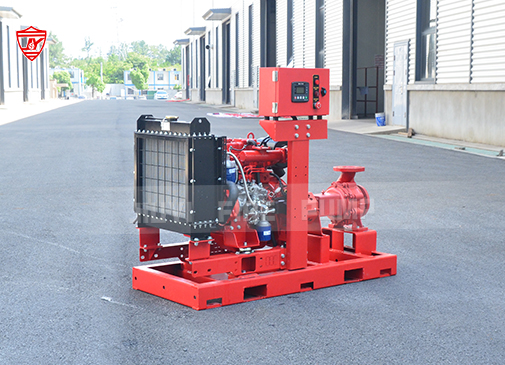
Common fire pump types used in warehouse applications include end suction, horizontal split case, vertical turbine, and other specialized configurations.
End suction fire pumps are commonly used for applications with moderate flow requirements and suitable installation conditions.
They can provide a compact solution and may be appropriate for smaller warehouse fire protection systems.
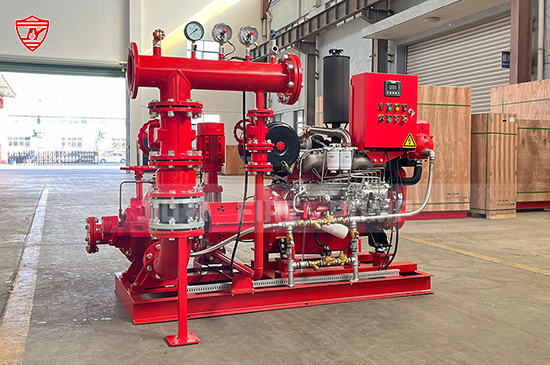
Horizontal split case pumps are widely used for larger fire protection applications where higher flow capacity and robust continuous-duty performance are required.
Their design also provides convenient access for maintenance, which can be valuable for industrial and warehouse facilities.
A vertical turbine fire pump may be considered when the available water source is located below the pump, such as a water storage tank, reservoir, or other below-grade water source.
The vertical configuration allows the pump to draw water from deeper sources while meeting the required fire protection demand.
The correct pump type depends on the project conditions, including water source, required flow, pressure, available space, installation arrangement, and applicable requirements.
Another major decision is the selection of the pump driver.
Electric and diesel engines are both widely used for fire pump systems.
An electric fire pump uses an electric motor as its driver.
Advantages can include:
Simple operation
Reliable starting when the electrical supply is properly designed
Lower routine maintenance compared with diesel engines
No diesel fuel storage
Suitable installation for facilities with reliable power infrastructure
However, the electrical supply must be appropriately designed for the fire pump system. Engineers should consider the reliability of the power source and the requirements for fire pump electrical service.
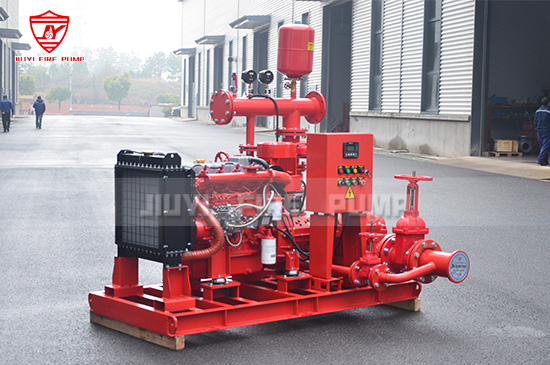
A diesel fire pump uses a diesel engine as the driver.
Diesel-driven fire pumps can provide an independent power source when electrical power reliability is a concern.
A diesel fire pump system requires additional components and maintenance, including:
Diesel fuel tank
Batteries
Battery charger
Engine controller
Exhaust system
Ventilation
Cooling system
Fuel management
For warehouses where power availability is limited or where independent power is required by the project design, a diesel fire pump can be an important part of the fire protection strategy.
A jockey pump is a small pump designed to maintain pressure in a fire protection system during normal conditions.
It is not intended to provide the main fire flow required during a fire.
A jockey pump helps compensate for small pressure losses and prevents the main fire pump from starting unnecessarily due to minor leakage or pressure fluctuations.
The jockey pump should be properly coordinated with the main fire pump and system pressure settings.
For many warehouse fire protection systems, the complete package may therefore include a main electric or diesel fire pump together with a jockey pump and appropriate controllers.
Do not select a fire pump based only on its nominal flow rating.
The pump performance curve is essential.
A performance curve shows how the pump performs at different flow rates and pressures. Engineers should verify that the required operating point falls within the appropriate portion of the pump curve.
Important points to evaluate include:
Rated flow
Rated pressure
Shutoff pressure
Pressure at rated flow
Pressure at higher flow
Motor or engine power requirements
Suction conditions
The selected pump should satisfy the hydraulic demand without creating excessive pressure at other operating conditions.
Performance should also be evaluated across the expected operating range rather than at only one point.
The water source has a direct influence on fire pump selection.
Potential water sources include:
Municipal water supply
Fire water storage tanks
Reservoirs
Underground tanks
Other dedicated water supplies
Before selecting the pump, engineers should understand the available suction pressure and water supply characteristics.
If the incoming water supply is insufficient to meet the required flow and pressure, the fire pump must provide the additional pressure needed by the system.
For water storage tanks or reservoirs, the available water level and pump configuration must also be considered.
A vertical turbine pump, for example, may be appropriate for certain deep-water-source applications where a conventional horizontal pump arrangement is not suitable.
Fire pumps are safety-critical equipment. Certification and compliance requirements should therefore be considered early in the selection process.
Depending on the project location, specification, insurance requirements, and authority having jurisdiction, the project may require specific certifications or approvals.
For international fire protection projects, UL Listed fire pumps and other recognized certification requirements may be specified.
However, certification should always be evaluated according to the actual project specification and applicable regulations.
The pump, motor or diesel engine, controller, and other components should also be properly matched as a complete fire pump system.
A good fire pump is not only capable of meeting hydraulic requirements; it should also be practical to install, inspect, test, and maintain.
Before final selection, consider:
Pump room dimensions
Equipment access
Pipe arrangement
Foundation requirements
Ventilation
Exhaust requirements for diesel engines
Electrical connections
Fuel storage
Drainage
Maintenance access
Testing requirements
Spare parts availability
For large warehouse projects, maintenance access is particularly important because fire protection equipment may remain inactive for long periods but must operate immediately when required.
A pump room should therefore be designed with enough space for inspection, testing, servicing, and component replacement.
Oversizing is a common mistake in pump selection.
It may seem safer to choose a larger pump, but a pump that is significantly larger than the hydraulic requirement can create its own problems.
Potential issues include:
Excessive system pressure
Higher equipment costs
Larger electrical or diesel power requirements
Increased pipe and valve requirements
More complicated system control
Unnecessary operating costs
The objective should be to select a pump that meets the calculated fire protection demand with appropriate performance margins, rather than simply selecting the largest available model.
Fire pump selection involves more than choosing a model from a catalog.
An experienced fire pump manufacturer should be able to support customers with:
Pump selection
Hydraulic performance data
Pump curves
Motor selection
Diesel engine selection
Controller matching
Jockey pump selection
Factory testing
Certification documentation
Installation information
Technical support
Spare parts and after-sales service
Manufacturers with their own testing facilities can also provide valuable performance verification before equipment is shipped to the project site.
For international warehouse projects, experience with different fire protection standards and certification requirements can further simplify the equipment selection process.
.jpg)
Selecting a fire pump for a warehouse requires a system-based approach. The correct pump should be determined by the actual fire protection demand, including required flow, pressure, elevation, water source, sprinkler configuration, and other hydraulic requirements.
The main factors to consider are:
Warehouse size and storage conditions
Fire hazard and commodity classification
Required sprinkler and hose stream flow
Required system pressure
Building and sprinkler elevation
Water supply characteristics
Fire pump type
Electric or diesel driver
Jockey pump requirements
Pump performance curve
Certification and project specifications
Installation and maintenance conditions
For warehouse fire protection systems, the goal is not simply to find a powerful pump. The goal is to select a properly sized and correctly configured fire pump that can deliver the required water flow and pressure when the system needs it.
As a fire pump manufacturer, we recommend evaluating every warehouse project based on its individual hydraulic requirements and installation conditions. A properly selected fire pump, combined with suitable system design, testing, and maintenance, provides an important foundation for reliable warehouse fire protection.