Choosing the right diesel fire pump is one of the most important decisions in designing a reliable fire protection system. A fire pump must provide the required water flow and pressure when the fire protection system needs it most. Unlike ordinary water pumps, fire pumps are designed for emergency applications where reliability, correct sizing, and compliance with applicable standards are critical.
Diesel fire pumps are commonly used in commercial buildings, industrial facilities, warehouses, power plants, oil and gas facilities, data centers, infrastructure projects, and locations where reliable electrical power cannot be guaranteed. They can also serve as a backup driver for fire pump systems when the electrical supply is considered insufficient or unreliable.
However, selecting a diesel fire pump is not simply a matter of choosing the largest pump available. An oversized or incorrectly configured pump can create unnecessary costs, installation problems, and system performance issues. The right selection should be based on hydraulic requirements, project conditions, applicable standards, driver characteristics, and long-term operating requirements.
This guide explains the key factors to consider when choosing a diesel fire pump for your project.
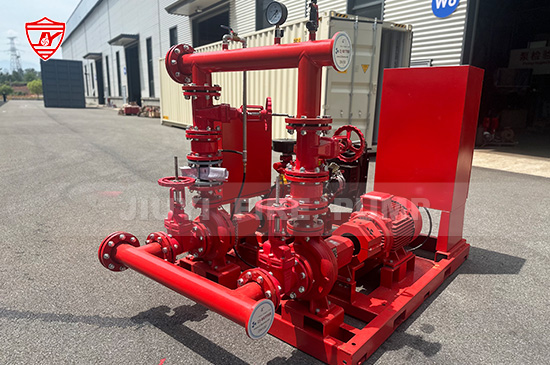
The first step in selecting a diesel fire pump is understanding the hydraulic demand of the fire protection system.
The pump must provide sufficient flow at the required pressure for the most demanding part of the system. The required flow may depend on the sprinkler system, hydrants, hose stations, standpipes, deluge systems, or other fire protection equipment installed at the facility.
Two basic questions should be answered:
For example, a project may require a fire pump capable of delivering 1,000 GPM at a specified pressure. The final pump selection should then be based on the system's hydraulic calculation rather than simply selecting a pump based on the building size.
It is important to consider pressure losses in pipes, valves, fittings, elevation changes, and other components. The pump must have sufficient capacity to overcome these losses while maintaining the required pressure at the point of demand.
Hydraulic calculations prepared by a qualified fire protection designer are therefore an essential starting point for diesel fire pump selection.
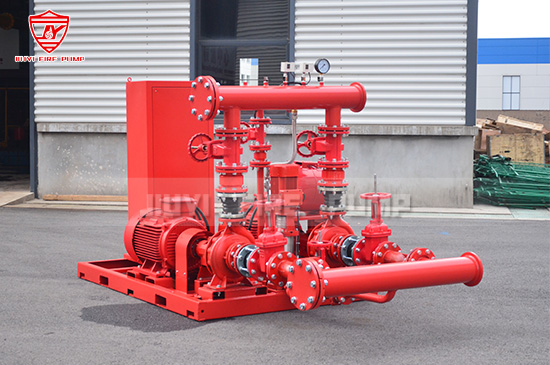
Different projects may require different fire pump configurations. Common types include horizontal split case pumps, end suction pumps, vertical inline pumps, and vertical turbine pumps.
Horizontal split case pumps are widely used for medium and large fire protection systems because they can provide high flow rates and are designed for reliable long-term operation. They are commonly found in industrial facilities, commercial buildings, warehouses, and large infrastructure projects.
End suction fire pumps can be suitable for applications where space is more limited or where the required flow and pressure fall within the pump's available range.
Vertical turbine pumps are typically considered when the water source is located below the pump, such as certain tanks, wells, reservoirs, or underground water sources.
The pump type should therefore be selected according to the water source, required flow, pressure, installation conditions, available space, and applicable project requirements.
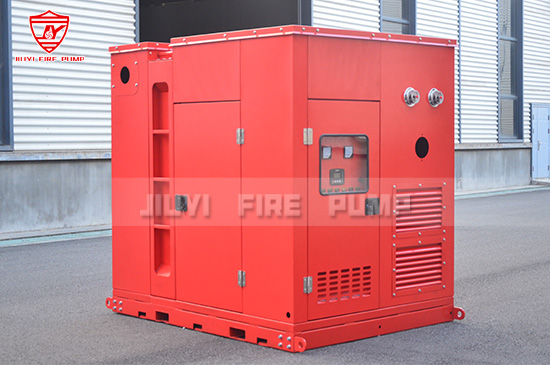
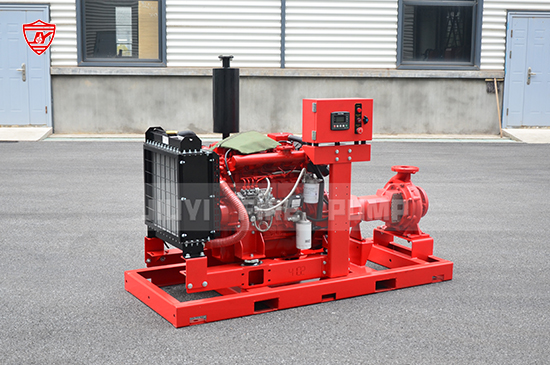
A diesel fire pump is a complete system consisting of the pump, diesel engine, controller, fuel system, batteries, cooling system, exhaust system, and other necessary components.
The diesel engine must have sufficient power to drive the selected pump throughout the required operating range.
Selecting an engine that is too small can prevent the pump from achieving its required performance. On the other hand, selecting an unnecessarily large engine may increase equipment costs, fuel consumption, installation requirements, and maintenance requirements.
The engine and pump should therefore be properly matched by the manufacturer based on the pump's performance curve and required operating conditions.
For projects requiring certified equipment, the engine should also meet the applicable certification and project requirements.
A pump's rated flow and pressure are important, but they are not the only performance characteristics that should be considered.
The pump performance curve shows how pressure changes as flow increases. It helps engineers determine whether the pump can meet the required operating conditions.
When reviewing a fire pump curve, consider:
The selected pump should satisfy the project's hydraulic requirements while remaining within the applicable performance requirements.
A reputable fire pump manufacturer should be able to provide a certified or tested performance curve for the selected pump model.
For many international fire protection projects, certification and compliance are major selection criteria.
Depending on the project location and specification, the fire pump system may need to comply with requirements such as NFPA 20 or be supplied with UL Listed and/or FM Approved components.
NFPA 20 provides requirements related to the selection and installation of stationary pumps for fire protection. However, the exact requirements applicable to a project should always be confirmed with the project's fire protection engineer, authority having jurisdiction, insurer, and applicable local regulations.
When a project specifies UL Listed or FM Approved equipment, it is important to verify that the actual pump, diesel engine, controller, and other required components have the appropriate certification for the intended application.
Do not assume that a manufacturer's general certification automatically applies to every model or configuration. Always check the certification details for the specific equipment being offered.
The water source has a significant impact on fire pump selection.
Before selecting the pump, determine whether the water comes from a dedicated fire water tank, municipal water supply, reservoir, underground tank, or another source.
The available suction pressure and water level must also be considered. Insufficient suction conditions can affect pump performance and may result in cavitation or other operational problems.
For applications where the water source is below the pump, a vertical turbine arrangement may be required. For other applications, a horizontal or end suction configuration may be more appropriate.
The pump manufacturer should receive accurate information about the water source, suction pipe arrangement, water level, and installation conditions before final selection.
A diesel fire pump requires a reliable fuel supply during an emergency.
The fuel tank should be appropriately sized according to project requirements, applicable standards, engine fuel consumption, and required operating duration.
Fuel consumption can vary depending on engine size and operating load. Therefore, the fuel tank should not be selected based only on the engine's rated power.
The complete diesel fire pump package should also consider fuel piping, fuel filtration, tank location, ventilation, and accessibility for inspection and maintenance.
A properly designed fuel system helps ensure that the diesel engine can operate when the fire protection system requires it.
The diesel engine fire pump controller is another critical component of the system.
The controller monitors and controls the diesel engine and provides important functions such as automatic starting, manual starting, monitoring, alarms, battery management, and system status indication.
For a complete fire pump package, the controller should be compatible with the selected diesel engine and pump system.
Project specifications may also require particular controller features, certifications, communication functions, or monitoring arrangements. These requirements should be reviewed before ordering the equipment.
A technically suitable fire pump may still be difficult to install if the physical conditions are not considered during selection.
Check the available pump room space, equipment access, foundation requirements, ventilation, exhaust routing, fuel tank location, maintenance clearance, and lifting requirements.
Diesel engines also produce heat and exhaust gases, so appropriate ventilation and exhaust arrangements are necessary.
Maintenance access should be considered from the beginning. Operators need sufficient space to inspect the engine, batteries, filters, fuel system, controller, pump components, and other equipment.
A good fire pump design should not only perform correctly but also allow safe and practical inspection and maintenance.
Fire pumps are emergency equipment. Their value is not measured only by purchase price.
When comparing manufacturers, evaluate their experience in fire protection equipment, testing capabilities, manufacturing quality, certification experience, technical support, spare parts availability, and after-sales service.
A reliable manufacturer should be able to provide technical documentation such as pump performance curves, dimensional drawings, engine information, controller specifications, installation requirements, and relevant certification documents.
Factory testing is also important. Proper testing helps verify that the pump and engine combination performs according to the specified requirements before shipment.
For international projects, it can also be beneficial to work with a manufacturer that understands different market requirements and has experience supplying complete fire pump systems to international customers.
Price is an important commercial consideration, but it should not be the only factor when selecting a diesel fire pump.
A lower initial price may result in higher long-term costs if the equipment has poor efficiency, limited spare parts availability, difficult maintenance, inadequate documentation, or insufficient technical support.
Instead, compare the complete value of the system, including equipment quality, certification, testing, delivery, installation requirements, maintenance, spare parts, warranty, and technical support.
For critical fire protection applications, reliability should remain a primary consideration.
The best time to involve the fire pump manufacturer is before the final equipment specification is completed.
Provide the manufacturer with the required flow, pressure, water source, suction conditions, system configuration, applicable standards, voltage and frequency requirements for auxiliary equipment, installation location, and project-specific requirements.
The manufacturer can then recommend a suitable pump model, diesel engine, controller, fuel tank, and complete fire pump package.
This approach can help avoid common problems such as selecting an unsuitable pump size, insufficient engine power, incorrect system configuration, or missing certification requirements.
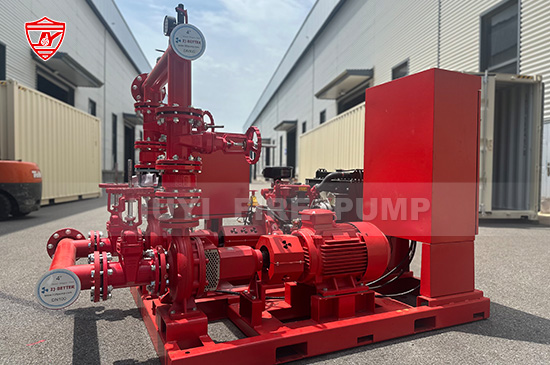
Choosing a diesel fire pump requires more than selecting a pump based on flow and pressure. A reliable selection should consider hydraulic demand, pump type, diesel engine power, performance curves, water source, fuel capacity, controller requirements, installation conditions, applicable standards, certification, testing, and long-term service.
For projects where fire protection reliability is critical, the complete fire pump package should be evaluated as one integrated system.
By working with an experienced fire pump manufacturer and providing accurate project information at the design stage, engineers, contractors, and facility owners can select a diesel fire pump that meets the required performance and provides dependable emergency protection.
For a fire pump manufacturer, the goal is not simply to supply a pump. It is to provide a properly engineered fire protection solution that can perform when it matters most.