
Fire pump hydraulic design is one of the most important parts of a reliable fire protection system. A properly designed fire pump must deliver sufficient water flow and pressure to the most demanding areas of a fire protection system while working reliably under emergency conditions.
Unlike ordinary water supply pumps, fire pumps are designed specifically to support fire protection systems such as automatic sprinklers, standpipes, hydrants, hose stations, and other fire suppression equipment. The pump must be selected based on actual hydraulic requirements rather than simply choosing a larger pump.
An effective hydraulic design considers required flow, required pressure, elevation, pipe friction losses, fittings, valves, water supply conditions, pump characteristics, and system demand. Understanding these factors helps engineers, contractors, consultants, and building owners make better decisions when designing or selecting a fire pump system.
This guide explains the fundamental principles of fire pump hydraulic design and the key factors that should be considered before selecting a fire pump.
.jpg)
Fire pump hydraulic design is the process of determining how much water flow and pressure a fire pump must provide to meet the hydraulic demand of a fire protection system.
The basic design objective is simple: the fire pump must provide adequate flow at the pressure required by the system's most hydraulically demanding point.
A typical hydraulic calculation evaluates:
The final pump selection should provide sufficient performance without creating unnecessary pressure, excessive system stress, or inefficient operation.
A fire pump is only effective when it matches the requirements of the complete fire protection system.
If the pump is undersized, the system may fail to deliver enough water to sprinklers, hydrants, or standpipes during a fire. Insufficient pressure can prevent sprinkler heads or hose equipment from operating as intended.
On the other hand, selecting a pump that is significantly larger than necessary can also create problems. Excessive pressure may require additional pressure-control measures and can increase mechanical stress, energy consumption, and system cost.
Proper hydraulic design provides a balance between performance, reliability, compliance, and cost.
For manufacturers, hydraulic design also plays a critical role in developing pump hydraulic models. The impeller diameter, casing design, impeller geometry, rotational speed, and other hydraulic parameters directly influence pump performance.
The first major step in fire pump hydraulic design is determining the required flow rate.
Fire protection systems may require different flow rates depending on the building type, hazard classification, sprinkler design, standpipe configuration, hydrant requirements, and applicable codes and standards.
For example, an automatic sprinkler system may have a calculated sprinkler demand combined with a hose stream allowance. A standpipe system may have different flow requirements depending on the number and location of standpipes.
The required fire flow is therefore not simply a standard number that applies to every project.
Engineers typically begin with the hydraulic demand of the fire protection system and identify the most demanding operating scenario. The fire pump should then be capable of meeting that demand.
Common fire pump flow units include gallons per minute (GPM), liters per second (L/s), and cubic meters per hour (m³/h).
Flow alone is not enough to select a fire pump. The pump must also provide adequate pressure.
The required pump pressure generally needs to overcome several components:
Required pump pressure = system demand pressure + elevation loss + friction loss + other pressure losses − available supply pressure
The exact calculation depends on the system configuration and applicable design requirements.
System demand pressure is the pressure required at the hydraulically most demanding sprinkler, hose outlet, standpipe, hydrant, or other fire protection device.
Elevation also has a major impact. As water moves upward through a building, pressure decreases because of the static head created by elevation.
As a general hydraulic relationship, approximately 0.433 psi is required for every foot of water elevation in conventional U.S. units. In metric calculations, approximately 9.81 kPa is associated with each meter of water head.
For high-rise buildings, elevation can therefore become a major factor in fire pump sizing.
Water flowing through pipes loses pressure because of friction.
Friction loss depends on several factors, including:
Smaller pipes generally produce greater friction losses at the same flow rate. Increasing pipe diameter can reduce friction loss, although the larger pipe also increases material and installation costs.
Hydraulic calculations commonly use established calculation methods such as the Hazen-Williams equation or Darcy-Weisbach equation, depending on the application, project requirements, and applicable standards.
The hydraulic calculation should include the entire path from the water source to the most demanding point of the fire protection system.
A fire protection system contains much more than straight pipe.
Elbows, tees, reducers, check valves, control valves, strainers, backflow preventers, flow meters, and other components can all contribute to pressure loss.
Ignoring these losses can result in an undersized fire pump.
Engineers commonly convert fitting and valve losses into equivalent pipe lengths or use published loss coefficients to include them in hydraulic calculations.
For this reason, a detailed system model should include all significant components between the fire pump and the point of water discharge.
Before selecting a fire pump, it is essential to understand the available water supply.
The water source may be a municipal water system, dedicated fire water tank, reservoir, suction tank, or another approved source.
Important water supply parameters include:
A fire pump does not operate independently from the water supply. Its performance depends on the conditions at the suction side.
For systems using a water storage tank, the lowest expected water level should be considered when evaluating suction conditions.
After calculating the required flow and pressure, the engineer can identify the required pump duty point.
For example, a project may require a fire pump capable of delivering a specified flow at a specified pressure. The pump curve is then evaluated to determine whether the selected model can meet the requirement.
The pump curve provides important information about the relationship between flow and pressure.
A proper selection should consider not only the rated duty point but also the pump's broader performance range.
For certified fire pumps, the applicable listing and approval requirements also need to be considered. UL Listed and FM Approved equipment may have specific performance and construction requirements that influence pump selection.
A fire pump performance curve is one of the most important technical documents used during pump selection.
The curve typically shows pump pressure or head on the vertical axis and flow on the horizontal axis.
Several points on the curve are especially important:
Shutoff: The pressure produced when the pump operates at zero flow.
Rated point: The designated rated flow and pressure of the fire pump.
Peak or maximum flow condition: A higher-flow operating point used to evaluate pump performance.
A fire pump should not be evaluated only at its rated point. Its performance across the required operating range is important for understanding whether the pump will satisfy the overall system requirements.
The relationship between pressure, flow, and pump speed is determined by the pump's hydraulic design. Changes in impeller diameter, rotational speed, or hydraulic geometry can affect the resulting performance.
Suction conditions are another important part of fire pump hydraulic design.
The pump must receive an adequate supply of water at its suction inlet. Poor suction conditions can cause unstable operation, vibration, noise, or cavitation.
Engineers should evaluate the available suction head and compare it with the pump's requirements.
Important considerations include:
For installations drawing water from tanks, the relationship between the minimum water level and pump elevation should receive particular attention.
For many fire protection projects, NFPA 20 is an important reference for the selection and installation of stationary pumps for fire protection.
However, hydraulic design should not be treated as simply selecting a pump that meets one flow and pressure value.
A complete design must consider the relationship between the fire pump, water source, piping, valves, controllers, drivers, pressure-maintenance equipment, and downstream fire protection systems.
The applicable edition of the relevant standard, local regulations, authority requirements, and project specifications should always be verified for the specific installation.
The hydraulic requirements of a fire pump do not fundamentally change simply because the driver is electric or diesel.
The pump still needs to deliver the required flow and pressure.
However, the driver and control system introduce additional design considerations.
Electric fire pumps require appropriate electrical power capacity, starting equipment, and controllers.
Diesel engine fire pumps require appropriate engine sizing, fuel storage, ventilation, exhaust arrangements, cooling, batteries, and control equipment.
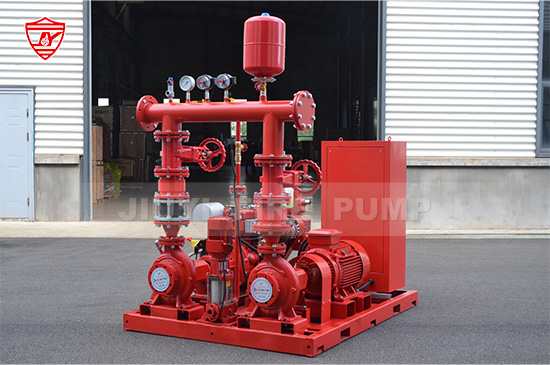
For critical fire protection systems, an electric pump and diesel pump may be combined with a jockey pump as part of an integrated fire pump system.
The hydraulic duty should be coordinated across the complete system so that the main fire pump and supporting equipment work together correctly.
A jockey pump is a small pressure-maintenance pump used to maintain system pressure when there are minor pressure fluctuations or small leakage losses.
It is not intended to provide the main fire flow required during a fire.
The jockey pump is generally selected to maintain system pressure without starting the main fire pump unnecessarily.
Proper pressure settings between the jockey pump and main fire pump are therefore important.
A correctly designed pressure-maintenance system can reduce unnecessary starts of the main fire pump and help maintain stable system pressure.
Several mistakes can reduce the reliability of a fire pump system.
One common mistake is selecting the pump based only on flow rate while ignoring required pressure.
Another is failing to account for elevation. This can be particularly serious in multi-story buildings.
Ignoring friction losses is another frequent problem. Even when the fire pump has adequate pressure at its discharge flange, the pressure available at the remote sprinkler or hose outlet may be insufficient after system losses.
Engineers should also avoid relying only on nominal pipe sizes without performing appropriate hydraulic calculations.
Finally, selecting a pump solely because it has a higher rated capacity is not necessarily better. The pump must be appropriate for the actual system duty and applicable fire protection requirements.
A professional fire pump manufacturer should provide more than a product catalog.
Technical support may include pump performance curves, certified data, dimensional drawings, hydraulic information, material specifications, driver data, and control system information.
Manufacturers can also assist engineers and contractors in matching pump models to specific flow and pressure requirements.
For fire pump manufacturers, hydraulic testing is particularly important. Performance testing verifies that the actual pump can achieve the expected flow and pressure characteristics.
At BETTER Technology Group, fire pump development and manufacturing are supported by dedicated testing capabilities for product performance verification and quality control. Hydraulic performance testing helps ensure that pump models are evaluated under controlled operating conditions before being supplied to customers.
.jpg)
Fire pump hydraulic design is the foundation of a reliable fire protection water supply system.
The process involves much more than choosing a pump with a high flow rate. Engineers must determine the required fire flow, calculate system pressure, account for elevation and friction losses, evaluate water supply conditions, and select a pump that matches the complete hydraulic duty.
A well-designed system should provide sufficient water flow and pressure at the most demanding point while maintaining reliable operation across the required operating range.
For fire pump manufacturers, accurate hydraulic modeling, controlled manufacturing processes, and performance testing are equally important. When hydraulic design and pump manufacturing are properly coordinated, the result is a fire protection system that provides dependable performance when it is needed most.
.jpg)
.jpg)