Fire pump rated flow is one of the most important specifications to understand when selecting, designing, or purchasing a fire pump system. It defines the flow capacity at which a fire pump is rated to operate and is closely connected with the required pressure, system demand, and overall fire protection performance.
For engineers, contractors, fire protection professionals, and building owners, understanding rated flow helps ensure that the selected fire pump can provide the required water supply when the fire protection system operates.
A fire pump is not simply selected according to its maximum possible flow. Instead, the pump must be matched to the hydraulic requirements of the fire protection system. Rated flow, rated pressure, suction conditions, piping losses, elevation, and sprinkler or hose demand all need to be considered together.
This article explains what fire pump rated flow means, how it relates to rated pressure, why it matters during pump selection, and what project professionals should consider before specifying a fire pump.
.jpg)
Fire pump rated flow is the flow rate at which a fire pump is designated to provide its rated performance.
It is commonly expressed in units such as gallons per minute (GPM), liters per minute (L/min), cubic meters per hour (m³/h), or cubic meters per second (m³/s), depending on the market and project requirements.
For example, a fire pump may have a rated flow of:
The rated flow should not be considered independently from rated pressure. A fire pump is normally identified by both its rated flow and rated pressure, such as a pump rated for 1,000 GPM at 125 psi.
This means the pump is designed and specified around a particular operating point rather than simply being a device capable of producing a certain maximum flow.
The primary purpose of a fire pump is to provide sufficient water flow and pressure to a fire protection system when the available water supply cannot meet system demand on its own.
If the rated flow is too low, the pump may not provide enough water for the required sprinklers, hose stations, hydrants, standpipes, or other fire protection equipment.
If the selected pump is substantially larger than the actual hydraulic requirement, the system may experience other problems, including excessive flow, pressure-related issues, inefficient operation, and difficulties during system commissioning.
Therefore, determining the appropriate rated flow is an important part of fire pump selection.
The rated flow should be based on the hydraulic demand established for the specific project rather than selected simply because a larger pump appears to provide greater protection.
Rated flow and maximum flow are not necessarily the same thing.
A fire pump may be capable of producing more flow than its rated flow under certain operating conditions. However, this does not mean that the maximum possible flow should be used as the pump's rated capacity.
The pump's performance is represented by its pump curve, which shows the relationship between flow and pressure. As flow changes, the pressure produced by the pump also changes.
For example, a pump rated at 1,000 GPM may produce:
The complete performance curve therefore provides much more information than the rated flow alone.
When selecting a fire pump, engineers should review the entire certified or approved performance data applicable to the pump rather than looking only at the nameplate rating.
The rated flow is normally established from the hydraulic requirements of the fire protection system.
The calculation begins with the water demand required by the protected building or facility. Depending on the application, this may include sprinkler demand, hose stream allowance, standpipe demand, hydrant requirements, special hazard systems, or other water-based fire protection equipment.
The required flow is then considered together with the pressure needed at the hydraulically most demanding point in the system.
The calculation may need to account for:
Once the hydraulic demand has been established, a fire pump with an appropriate rated flow and pressure can be selected.
The final pump selection should provide the required performance while remaining within the applicable requirements for the project and the pump's listing or approval.
One of the most common mistakes in fire pump selection is considering flow without pressure.
A pump that provides sufficient flow but insufficient pressure may not satisfy the system's hydraulic requirements. Likewise, a pump with very high pressure but insufficient flow may also be unsuitable.
For this reason, fire pump specifications often use a combination of flow and pressure.
For example:
1,500 GPM at 125 psi
In this example:
The actual pressure available at different flow rates must then be evaluated using the pump performance curve.
This relationship is especially important for large commercial buildings, warehouses, industrial facilities, high-rise buildings, and other applications where hydraulic requirements can be significant.
The duty point is the operating point where the required system flow and pressure intersect with the pump's performance.
For example, suppose a hydraulic calculation determines that a project requires 1,000 GPM at a specific pressure. The pump should be selected so that its performance at this operating condition meets the project's requirements.
The duty point is therefore a critical reference for pump selection.
However, the duty point is not necessarily the only point that needs to be reviewed. Fire pump performance should also be evaluated across the relevant operating range.
This is why experienced fire pump manufacturers provide performance curves and test data rather than relying only on a single flow and pressure value.
Not necessarily.
A higher rated flow does not automatically mean that a fire pump is better or more suitable for a project.
Fire pumps are designed for specific applications. A pump with a rated flow significantly higher than the system requirement may not be the appropriate choice.
The correct approach is to select a pump based on the actual hydraulic requirements of the fire protection system.
For example, a small commercial building may have very different water demand from a large distribution warehouse or an industrial facility. A high-rise building may have significant pressure requirements because of elevation, while another project may primarily require high flow.
The appropriate fire pump is the one whose performance matches the project's requirements and applicable specifications.
Rated flow is one of several factors used when selecting a fire pump.
A complete selection process may consider:
1. Required system flow
Determine the water flow required by the fire protection design.
2. Required pressure
Determine the pressure needed at the most demanding point of the system.
3. Available water supply
Evaluate the existing water source, including available pressure and flow.
4. Pump type
Consider whether the project requires an end-suction, split-case, vertical turbine, inline, or another suitable pump configuration.
5. Driver
Determine whether the pump will be driven by an electric motor or diesel engine.
6. Certification and listing requirements
Depending on the project, listed or approved equipment may be required.
7. Installation conditions
Consider suction conditions, available space, ambient temperature, ventilation, fuel requirements, electrical supply, and other site factors.
8. System configuration
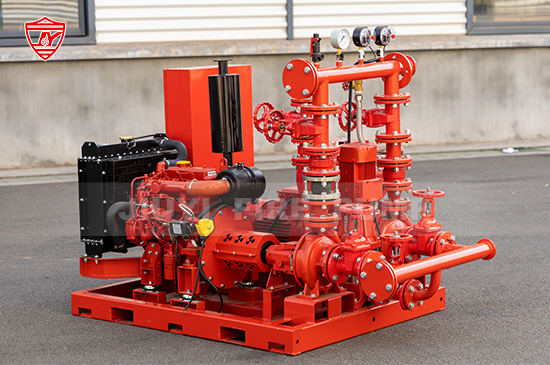
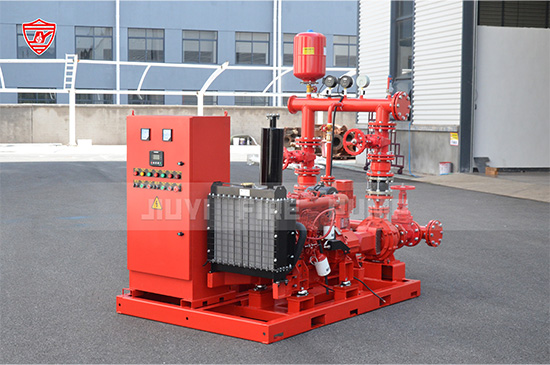
The fire pump may operate as part of an electric, diesel, or combined fire pump set that can also include a jockey pump and associated controllers.
Rated flow is therefore an important starting point, but it should always be evaluated as part of the complete fire pump system.
Fire pumps are manufactured in a wide range of rated flow capacities to meet different applications.
Smaller systems may require pumps in the range of several hundred GPM, while large industrial, commercial, municipal, or infrastructure projects may require pumps capable of several thousand GPM.
For example, a project may specify:
These figures are examples rather than universal requirements. The correct rated flow must always be established from the actual project design and applicable requirements.
Rated flow applies to both electric motor-driven and diesel engine-driven fire pumps.
The pump hydraulic performance is the primary consideration, while the driver must provide the power required to operate the pump at the specified conditions.
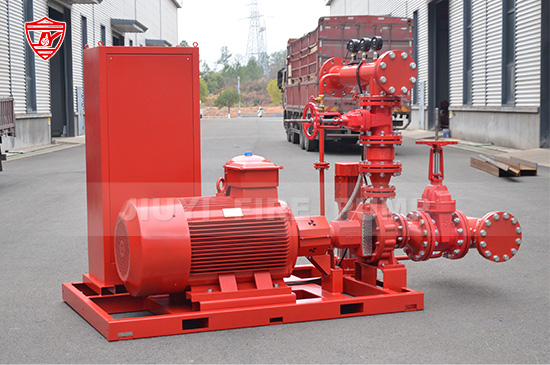
An electric fire pump may be paired with an electric motor and fire pump controller. A diesel fire pump uses a diesel engine and its associated control and fuel systems.
For projects requiring multiple drivers or additional redundancy, a fire pump system may include both electric and diesel-driven pumps together with a jockey pump.
Regardless of the driver type, the pump's rated flow must correspond to the hydraulic requirements of the fire protection system.
Fire pump manufacturers use testing to verify pump performance.
During a factory performance test, the pump can be operated at different flow conditions and the resulting pressure and other performance parameters can be measured.
Testing may include points such as:
The resulting data can be compared with the expected pump performance curve.
For fire pump manufacturers, accurate testing is essential because the customer depends on the pump to deliver the required water flow and pressure when the fire protection system is needed.
A properly equipped pump test facility can also help manufacturers verify hydraulic performance across different pump models and configurations.
When purchasing a fire pump, buyers should provide clear project requirements rather than simply asking for a pump with a certain motor power.
Important information may include:
Buyers should also request the pump performance curve and relevant technical documentation.
This information allows engineers and contractors to confirm that the selected pump can meet the project's hydraulic requirements.
Fire protection systems are designed to operate under emergency conditions, so reliability is a central consideration.
The fire pump must be capable of supplying the required water flow and pressure when the system demands it.
Correct rated flow selection contributes to this objective by ensuring that the pump is properly matched to the system demand.
However, reliability also depends on many other factors, including pump design, driver selection, controller performance, installation quality, maintenance, testing, and the condition of the water supply.
Rated flow is therefore an essential specification, but it is only one component of a complete fire protection system.
.jpg)
Fire pump rated flow is the specified flow capacity around which a fire pump's performance is established. It is normally considered together with rated pressure and the pump performance curve to determine whether the pump can meet the hydraulic requirements of a fire protection system.
Understanding rated flow helps engineers, contractors, building owners, and fire safety professionals make more informed decisions when selecting fire pumps.
The correct pump should not simply have the highest possible flow. Instead, its rated flow and pressure should be matched to the project's hydraulic demand, system configuration, available water supply, installation conditions, and applicable requirements.
As a fire pump manufacturer, we understand that every project has different flow, pressure, installation, and certification requirements. Accurate hydraulic evaluation, reliable pump manufacturing, and comprehensive factory testing are essential for delivering fire pump systems that perform as specified when they are needed most.