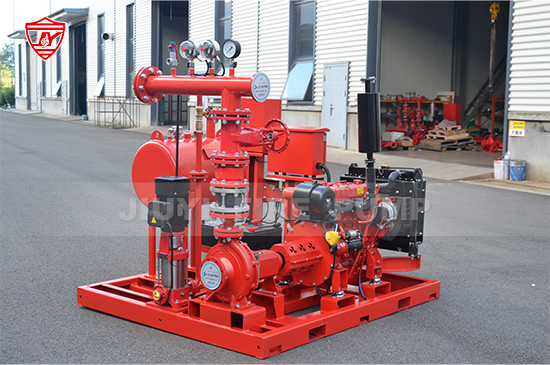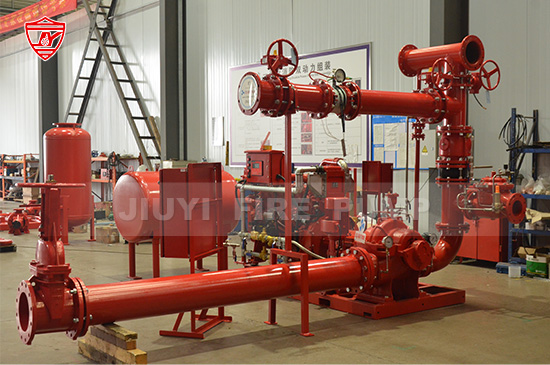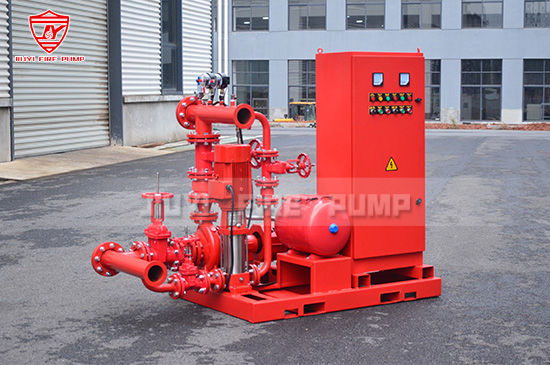
Fire pump rated pressure is the pressure a fire pump is designed to provide at its rated flow under specified operating conditions. Understanding rated pressure is essential when selecting a fire pump because the pump must provide sufficient pressure for sprinklers, hydrants, standpipes, hose systems, and other fire protection equipment.
For fire protection engineers, contractors, system designers, and project owners, rated pressure should never be considered as an isolated number. It must be evaluated together with rated flow, system demand, suction conditions, elevation, friction losses, and the requirements applicable to the project.
A correctly selected fire pump should deliver the required flow at the required pressure while maintaining acceptable performance across the operating range.
.jpg)
The rated pressure of a fire pump refers to the pressure the pump is expected to produce at its rated flow. It is normally expressed in PSI, bar, kPa, or other pressure units depending on the market and project requirements.
For example, a fire pump may have a rated capacity of 1,000 GPM at a rated pressure of 100 PSI. This means the pump is designed to provide approximately 1,000 gallons per minute while developing approximately 100 PSI under the specified test and operating conditions.
Rated pressure is therefore directly connected to rated flow.
A statement such as "1,000 GPM fire pump" does not provide enough information to select the correct pump. Two 1,000 GPM pumps can have very different pressure capabilities. One project may require 75 PSI at the pump discharge, while another may require 150 PSI because of building height, piping losses, or equipment requirements.
For this reason, fire pump selection should always consider both flow and pressure.
Fire pump performance is based on the relationship between flow and pressure.
The rated point represents a specific combination of flow and pressure. For example:
At this rated point, the pump is expected to meet the specified performance requirements.
However, the pump does not operate at only one point. As flow changes, discharge pressure also changes. This relationship is shown on the fire pump performance curve.
As flow increases, the pressure generated by a centrifugal fire pump generally decreases. At low or zero flow, the pump can develop a higher pressure than its rated pressure. As system demand increases, the pump operates at a different point on its performance curve.
This is why looking only at the rated pressure printed on a pump nameplate is not sufficient. Engineers and contractors should evaluate the complete pump curve when selecting equipment.
Rated pressure and shutoff pressure are two different values.
Rated pressure is associated with the pump's rated flow. Shutoff pressure, sometimes called churn pressure, is the pressure the pump develops when there is little or no flow through the pump.
For example, consider a fire pump rated at:
1,000 GPM at 100 PSI
Its shutoff pressure may be higher than 100 PSI. The exact value depends on the pump design and performance curve.
This distinction is important because the fire protection system must be capable of handling the pressure produced by the pump at different operating conditions.
A common mistake is to assume that a 100 PSI rated fire pump can never produce more than 100 PSI. In reality, the pump can produce a higher pressure at lower flow.
Therefore, system components such as pipes, valves, fittings, sprinkler equipment, and other pressure-sensitive components must be selected with the complete operating pressure range in mind.
Determining the appropriate rated pressure begins with the hydraulic requirements of the fire protection system.
The required pressure at the pump discharge generally needs to account for several factors, including:
For a simplified example, suppose a sprinkler system requires 60 PSI at the hydraulically most demanding location.
If elevation and piping losses between the fire pump and that location require another 35 PSI, the pump needs to provide approximately 95 PSI at the required flow before other design considerations are evaluated.
The final selected pump rating may therefore be around 100 PSI rather than simply matching the 60 PSI required at the sprinkler.
Actual system calculations should be performed by qualified fire protection professionals based on the project design and applicable requirements.
Building elevation is one of the most important factors affecting required fire pump pressure.
Water pressure decreases as elevation increases. In simplified terms, approximately 0.433 PSI is required for every foot of vertical elevation in water systems.
This means that a high-rise building can require substantially more pump pressure than a low-rise building, even when the required flow is similar.
For example, if a fire pump must supply water to equipment located significantly above the pump room, the pump must overcome the static elevation difference before accounting for friction losses and the pressure required at the fire protection device.
This is one reason high-rise buildings may require higher-pressure fire pumps, multiple pressure zones, or other system arrangements.
The final pressure requirement should always be established through hydraulic calculations rather than estimated solely from building height.
Fire pump rated pressure should not automatically be treated as the same thing as system operating pressure.
A fire protection system can have pressure at the pump suction before the pump operates. This is particularly relevant when the water supply is provided by a municipal water system, elevated tank, gravity tank, or other pressurized source.
The fire pump adds pressure to the available suction pressure.
For example, if the available suction pressure is 30 PSI and the pump produces an additional 100 PSI at rated flow, the resulting discharge pressure may be approximately 130 PSI before accounting for other pressure effects.
However, actual pump selection requires evaluation of the complete suction and discharge conditions.
This is particularly important when the water source provides positive suction pressure. The total pressure available to the system may therefore be different from the fire pump's rated pressure alone.
The performance curve is one of the most important documents for understanding a fire pump.
A typical curve shows the relationship between pump flow and pressure. It allows engineers to determine how the pump will perform at different flow conditions.
When evaluating a pump curve, important points may include:
The curve helps confirm whether the selected pump can satisfy the hydraulic demand of the fire protection system.
For example, a pump that provides the required 100 PSI at 1,000 GPM may not be suitable if the system also requires a higher flow condition that causes the pump pressure to fall below the required level.
Therefore, pump selection should be based on the complete performance curve rather than a single rated-pressure value.
Selecting the correct fire pump rated pressure requires more than choosing a higher pressure rating.
The first step is to determine the required fire protection flow. This may be based on sprinkler demand, hydrant demand, standpipe demand, hose stream requirements, or a combination of system demands.
The next step is to determine the pressure required at the hydraulically most demanding point.
The system designer then evaluates elevation, pipe friction, fittings, valves, equipment losses, and other pressure requirements.
The resulting hydraulic demand establishes the approximate pump duty point.
The fire pump should then be selected so that its performance curve satisfies the required flow and pressure while also complying with the applicable fire protection requirements.
Oversizing the pressure rating is not always the best solution. An excessively high-pressure pump can create additional challenges for system components, pressure control, equipment selection, and overall system design.
The goal is to select a pump that properly matches the project's hydraulic requirements.
If the selected fire pump cannot provide sufficient pressure at the required flow, the fire protection system may not achieve its intended hydraulic performance.
Potential consequences include inadequate pressure at remote sprinklers, standpipe outlets, hydrants, or other fire protection equipment.
Low pressure can result from several causes, including:
This is why a pump should be evaluated as part of the complete fire protection system rather than as an independent piece of equipment.
Yes. Excessive pressure can also create problems.
A pump that generates significantly more pressure than required may expose system components to higher pressures than originally anticipated. Depending on the system design, pressure-reducing devices, pressure-regulating equipment, higher-pressure-rated components, or other engineering measures may be required.
High pressure can also affect system testing and commissioning.
For this reason, simply choosing the highest available fire pump pressure is not an appropriate selection method.
The correct approach is to match pump performance to the hydraulic requirements of the project and the pressure ratings of the system components.
Both electric-driven and diesel-driven fire pumps can be selected with different rated flow and pressure combinations.
The driver does not determine the required system pressure by itself. Instead, the pump must be selected according to the hydraulic demand, while the driver must provide sufficient power to operate the pump across the required performance range.
For an electric fire pump, the motor must have adequate horsepower and electrical characteristics for the selected pump.
For a diesel fire pump, the diesel engine must provide sufficient power under the specified operating conditions.
A complete fire pump set may also include a jockey pump, controller, valves, pressure-sensing equipment, and other components required by the project.
The electric or diesel driver therefore works together with the pump to provide the required fire protection performance.
For a fire pump manufacturer, rated pressure is not simply a marketing specification.
It is closely related to hydraulic design, impeller selection, pump casing design, shaft design, driver power, testing, and overall equipment configuration.
A manufacturer must verify pump performance through testing to confirm that the pump can achieve its specified flow and pressure characteristics.
Factory testing can help identify whether the actual pump performance corresponds with the required performance curve.
For customers, this provides important information when evaluating whether a fire pump is suitable for a specific project.
A reliable manufacturer should be able to provide the relevant technical information, including pump performance data, rated flow, rated pressure, speed, driver information, dimensions, and applicable certification or approval information when required.
Fire pump rated pressure is one of the fundamental specifications used to describe fire pump performance, but it should never be evaluated alone.
The most important points to remember are:
.jpg)
Understanding fire pump rated pressure is essential for anyone involved in fire protection system design, equipment selection, installation, and commissioning.
Rated pressure describes the pressure a fire pump is designed to provide at its rated flow, but the pump's actual operating pressure varies with flow and system conditions. For this reason, the rated point, shutoff pressure, performance curve, system demand, elevation, friction losses, and available water supply should all be considered together.
For project owners and contractors, choosing the right fire pump means looking beyond a single pressure number. A properly selected fire pump should provide the required flow and pressure while fitting the hydraulic requirements and equipment limitations of the complete fire protection system.
As a fire pump manufacturer, Better Technology Group provides fire pump solutions for different project requirements, including electric fire pumps, diesel fire pumps, jockey pumps, vertical turbine fire pumps, and complete fire pump sets. Proper selection begins with understanding the project's required flow and pressure and matching the pump performance to those requirements.