Flow rate and pressure are two of the most important performance parameters in a fire pump system. They determine how much water a fire pump can deliver and whether that water can reach the required locations with sufficient force. For fire protection engineers, system designers, contractors, and facility managers, understanding the difference between these two parameters is essential for selecting, sizing, and operating a reliable fire pump system.
Although flow rate and pressure are closely related, they describe different aspects of pump performance. A pump may deliver a large volume of water but fail to provide sufficient pressure at the required discharge point. Conversely, a pump may generate high pressure but deliver insufficient water to support the demands of a fire protection system.
Choosing the right fire pump requires a clear understanding of both parameters, the characteristics of the piping network, and the hydraulic requirements of the protected facility.
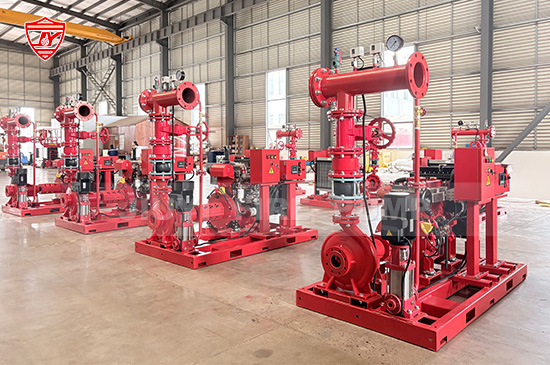
Flow rate refers to the volume of water a fire pump delivers within a specific period. It indicates how much water is available to supply a fire protection system, including sprinkler systems, hydrants, standpipes, and other approved firefighting equipment.
Flow rate is commonly measured in gallons per minute (GPM) in the United States and liters per second (L/s) or cubic meters per hour (m³/h) in many other markets.
For example, a fire pump rated at 500 GPM is designed to deliver 500 gallons of water per minute at its specified rated operating point and corresponding pressure.
Flow rate is particularly important in facilities where firefighting operations require large quantities of water. Industrial plants, warehouses, petrochemical facilities, commercial buildings, and port terminals may have different water demand requirements depending on their fire hazards, protection systems, and design criteria.
The required flow rate determines whether a fire pump can supply enough water to the system during a fire emergency.
If the flow rate is too low, sprinklers or hydrants may not receive the required water supply to support the intended firefighting operation. This can compromise the performance of the overall fire protection system.
When determining the required flow rate, engineers typically consider:
The hydraulic demand of the sprinkler or hydrant system.
The required number of simultaneously operating outlets or devices.
The applicable fire protection design standards and local regulations.
The occupancy type, building size, and fire hazard classification.
The availability and capacity of the water supply.
The specific requirements of the project and its approved hydraulic calculations.
The required flow rate should be established through a proper hydraulic design rather than selected solely according to building size or pump availability.
Pressure describes the force exerted by water per unit area. In a fire protection system, it indicates the ability of the water supply to overcome resistance and reach the required discharge points under the intended operating conditions.
Fire pump pressure is commonly measured in pounds per square inch (PSI), bar, or kilopascals (kPa).
For example, a fire pump rated at 500 GPM and 100 PSI is specified to deliver its rated flow at a rated discharge pressure of 100 PSI under the applicable rating conditions. Actual system performance depends on suction pressure, pump configuration, speed, and other operating factors.
Pressure is essential because water must travel through pipes, fittings, valves, elevation changes, and firefighting equipment before reaching the point of use.
A fire pump must provide enough pressure to overcome friction losses in the piping network and meet the pressure requirements of the protected equipment.
Several factors affect the pressure required in a fire protection system:
Elevation differences: Water requires additional pressure to move to higher floors or elevated discharge points. As a general approximation, a 10-meter elevation increase requires about 0.98 bar of additional pressure before accounting for friction losses and equipment requirements.
Pipe friction: Water flowing through pipes experiences resistance. Friction losses depend on pipe diameter, length, material, internal condition, flow rate, and the number and type of fittings.
System components: Valves, strainers, backflow prevention devices, sprinkler heads, nozzles, and other components can introduce additional pressure losses.
Required discharge pressure: Certain firefighting devices need a minimum residual pressure to operate as intended.
A properly selected fire pump must satisfy the required pressure at the relevant operating point while delivering the necessary flow rate.
The simplest way to understand the difference is to consider flow rate as the quantity of water delivered and pressure as the energy available to move that water through the system.
| Parameter | Flow Rate | Pressure |
|---|---|---|
| Definition | Volume of water delivered per unit of time | Force exerted by water per unit area |
| Common units | GPM, L/s, m³/h | PSI, bar, kPa |
| Main function | Determines water delivery capacity | Helps overcome elevation and system resistance |
| Key design question | How much water is required? | What pressure is required at the specified flow? |
| Factors affecting it | Pump design, speed, system resistance, water supply | Pump head, flow, elevation, friction losses, suction conditions |
| Typical application | Meeting sprinkler and hydrant water demand | Reaching remote or elevated discharge points |
Neither parameter can be considered independently when selecting a fire pump.
A system with a high water demand may require a large flow rate, while a tall building or an extensive piping network may require greater pump head. Many projects require both high flow and high pressure, but the exact combination must be determined by hydraulic calculations.
It is also important to distinguish pump discharge pressure from the pressure available at the end of the piping network. The latter may be considerably lower because of elevation and friction losses.
Flow rate and pressure are related through the pump's performance characteristics and the resistance of the connected system.
A centrifugal fire pump does not normally deliver the same pressure at every flow rate. Its performance is represented by a pump curve, which shows the relationship between flow and total head at a specified speed and impeller configuration.
For a typical centrifugal pump, the available head decreases as flow increases. At very low flow, the pump may develop its highest head, while at higher flow rates, the available head generally decreases.
This relationship is important because a pump that provides the required pressure at low flow may not provide the same pressure when the system demands a larger water volume.
A fire pump performance curve usually identifies several important operating characteristics:
Rated point: The specified rated flow and rated head or pressure relationship at the pump's rated operating condition.
Shutoff head: The head developed when the pump operates at zero flow. This is not a normal firefighting operating point, and prolonged operation under this condition can cause overheating or other problems.
Maximum flow region: The higher-flow portion of the curve, where the pump develops less head. The available pressure must still meet the applicable performance requirements.
Efficiency and power characteristics: These indicate how efficiently the pump operates and how much power the driver must provide at different operating points.
The actual operating point is determined by the intersection of the pump curve and the system curve. Consequently, the same pump may operate at different flow rates and pressures in different piping systems.
For fire protection applications, engineers should evaluate the complete performance curve rather than rely on a single advertised flow rate or pressure value.
Correct fire pump selection begins with determining the hydraulic demand of the system.
Calculate the water demand based on the approved fire protection design. For a sprinkler system, this involves the applicable design density, operating area, and any required additional water allowances. Hydrant and standpipe demands must be assessed according to the relevant design criteria.
For example, if the calculated system demand is 400 GPM, the selected fire pump must be capable of meeting that demand at the required pressure.
This does not automatically mean that a 400 GPM rated pump is suitable. The complete pump curve, applicable standards, and project requirements must be checked.
The required pump discharge pressure depends on the pressure needed at the critical discharge point, elevation changes, friction losses, and suction pressure.
A simplified relationship is:
Required pump discharge pressure = Required residual pressure + Elevation pressure loss + Friction losses + Other equipment losses.
Where a positive suction pressure is available, it contributes to the pressure available from the system. Therefore, when calculating the pressure rise the pump must provide, the suction pressure must be accounted for.
In head terms, the relationship is:
Required pump head = Required system head at discharge − Available suction head, with all terms expressed on a consistent basis.
For accurate design, engineers must also consider velocity head, pressure measurement locations, and the specific hydraulic calculation method.
Once the flow and pressure requirements are established, compare the calculated duty point with the manufacturer's pump performance curve.
The selected pump should meet the required operating conditions while complying with applicable fire pump standards, project specifications, and driver power requirements.
For a practical example, consider a project requiring 500 GPM at a specified pump duty point corresponding to 100 PSI of pressure rise. A candidate pump must be evaluated to confirm that it can deliver the required flow and pressure simultaneously. A pump that reaches 100 PSI only at a much lower flow rate would not satisfy that duty point.
This is why selecting a fire pump based on flow rate or pressure alone can result in an unsuitable system.
Several technical and installation factors influence actual fire pump performance.
Different pump configurations serve different hydraulic requirements. Horizontal split-case pumps are commonly used for high-flow applications, while end-suction pumps may suit a range of building and industrial applications. Vertical turbine pumps are useful where the water source is below the pump installation level, such as certain tanks, reservoirs, and wells.
The appropriate design depends on the required flow, head, water source, installation conditions, and project specifications.
Electric motors and diesel engines supply the mechanical power required to operate fire pumps. The driver must be appropriately matched to the pump and capable of meeting its power requirements throughout the required operating range.
Insufficient available power, incorrect speed, or driver-related problems can prevent the pump from achieving its expected performance.
The water supply must provide suitable suction conditions. Restricted suction piping, inadequate water levels, air ingress, excessive suction losses, or other supply limitations can affect pump performance and may contribute to cavitation.
A fire pump cannot reliably deliver its intended performance if the water supply is inadequate.
Undersized pipes, excessive fittings, partially closed valves, clogged strainers, and other restrictions can increase system resistance. These conditions may reduce delivered flow and change the pump's operating point.
Correct piping design and installation are therefore essential to achieving the specified duty conditions.
Wear, corrosion, mechanical damage, and other defects can affect pump efficiency and reliability. Regular inspection and testing help identify performance deviations before an emergency occurs.
Understanding the relationship between flow and pressure helps prevent several common design and procurement mistakes.
Selecting a pump based only on rated flow. A pump may have the required GPM rating but fail to meet the required pressure at that flow.
Choosing the highest available pressure. Excessive pressure is not automatically beneficial. Unnecessarily high system pressure may exceed the ratings of pipes, valves, and other components or require additional pressure management measures.
Ignoring elevation and friction losses. The pressure required at the pump discharge is not necessarily the same as the pressure needed at the most remote sprinkler or hydrant.
Ignoring the pump curve. A single rated point does not fully describe pump performance across different flow conditions.
Overlooking the water supply. The selected pump must be compatible with the available suction conditions and source capacity.
Failing to verify actual performance. Installation quality, system resistance, driver condition, and water supply limitations may cause actual results to differ from expectations.
A comprehensive selection process considers the hydraulic calculations, pump curve, driver power, water supply, installation requirements, and applicable fire protection standards.
Testing confirms whether a fire pump performs according to its specified requirements. Commissioning and periodic testing should follow the applicable standard, approved test procedure, and manufacturer's instructions.
During a typical performance test, technicians measure suction pressure, discharge pressure, flow rate, driver speed, and other relevant operating parameters.
Testing commonly evaluates the pump at multiple flow conditions, including churn or no-flow operation, rated flow, and the applicable overload or maximum-flow test point specified by the governing requirements.
Flow measurement may use a calibrated flow meter or an approved test arrangement. Pressure gauges and instruments should be suitable for the expected operating range and properly calibrated.
Test results are compared with the manufacturer's certified performance data and the acceptance criteria applicable to the installation.
If the measured flow or pressure differs significantly from the expected values, technicians should investigate potential causes, including water supply restrictions, incorrect valve positions, measurement errors, pump damage, speed deviations, and piping losses.
Testing should be performed by qualified personnel using appropriate safety precautions. Fire protection systems must remain properly protected during testing, and any impairment should be managed according to the facility's approved procedures.
The right fire pump is not necessarily the pump with the highest flow rate or the highest pressure. It is the pump that meets the project's required hydraulic duty point while satisfying applicable standards, installation constraints, and operational requirements.
Before selecting a fire pump, project engineers and procurement teams should establish the following:
Required flow rate and discharge pressure or total head.
Applicable fire protection standards and approval requirements.
Water source, suction pressure, and available water capacity.
Building height, piping layout, and hydraulic losses.
Pump type and installation configuration.
Electric motor or diesel engine driver requirements.
Controller, accessories, and system integration requirements.
Testing, commissioning, maintenance, and documentation needs.
For industrial facilities, warehouses, ports, petrochemical plants, and large commercial buildings, these considerations may differ significantly. A detailed project review helps ensure that the selected equipment is suitable for the actual operating conditions.
Working with an experienced fire pump manufacturer can help engineers and contractors evaluate pump curves, compare configurations, and identify suitable equipment for specific applications. Manufacturers should provide clear performance data and technical documentation to support engineering review and project verification.
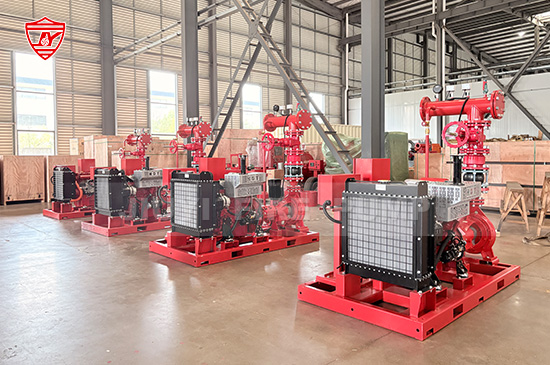
Flow rate and pressure serve different but equally important functions in fire pump performance. Flow rate determines how much water the pump can deliver over time, while pressure represents the energy available to move that water through the fire protection system.
A reliable fire pump selection must account for both parameters at the same operating point. Hydraulic calculations, pump performance curves, suitable driver selection, proper installation, and performance testing all contribute to a dependable fire protection system.
As a fire pump manufacturer, BETTER Technology Group understands the importance of matching pump performance to project requirements. By evaluating flow, pressure, water supply conditions, and application needs together, project teams can make more informed equipment decisions and support reliable fire protection for buildings and industrial facilities.