Calculating fire pump head requirements is a critical step in designing and selecting a reliable fire protection system. The fire pump must generate enough pressure to overcome elevation, friction losses, and the pressure required at the most demanding point of the system.
If the required head is underestimated, the fire pump may not provide sufficient pressure to sprinklers, hydrants, hose stations, or standpipes. If it is significantly oversized, the system may experience excessive pressure and unnecessary equipment and operating costs.
For engineers, contractors, consultants, and fire protection professionals, understanding how to calculate fire pump head provides a practical foundation for selecting the appropriate fire fighting pump.
This article explains the main components of fire pump head, the calculation process, common formulas, and important considerations when selecting a fire pump.
.jpg)
Fire pump head is the amount of energy per unit weight that a fire pump adds to the water. It is commonly expressed as meters of water head, feet of head, bar, or PSI.
In practical fire protection applications, pump head represents the pressure that the pump needs to provide to move water from the available water source to the required discharge point while maintaining the required residual pressure.
Fire pump head is influenced by several factors:
Required system pressure
Elevation difference
Pipe friction loss
Fittings and valves
Equipment losses
Available suction pressure
Flow rate
Required pressure at the remote or hydraulically most demanding point
The required pump head should therefore be calculated as part of the overall hydraulic design rather than selected independently.
Head and pressure describe related characteristics but use different units.
Pump manufacturers may provide performance data in either pressure or head.
A commonly used relationship for water is:
1 bar ≈ 10.2 meters of water head
and:
1 meter of water head ≈ 0.098 bar
In imperial units:
1 psi ≈ 2.31 feet of water head
Therefore, a pump rated at approximately 100 meters of head produces around 9.8 bar of pressure under standard water conditions.
The exact relationship can vary slightly depending on water density and temperature, but these conversions are useful for preliminary fire pump calculations.
A simplified way to determine the required fire pump head is:
Required Pump Head = Static Head + Friction Loss + Required Residual Head - Available Suction Head
Each part of this equation represents a different hydraulic requirement.
Static head is the vertical elevation difference between the water source and the point where the required pressure must be maintained.
For example, if the water level in a fire tank is 5 meters below the reference point and the hydraulically most demanding sprinkler is 35 meters above the pump, the elevation difference is significant and must be included in the calculation.
The greater the elevation, the greater the pump head required.
For water:
10 meters of elevation requires approximately 1 bar of pressure.
This is why high-rise buildings often require considerably greater fire pump pressure than low-rise buildings.
Water loses pressure as it flows through pipes.
This pressure loss is known as friction loss and depends on factors such as:
Pipe length
Pipe diameter
Flow rate
Pipe material
Internal pipe roughness
Number of fittings
Valves
Bends
Tees
Reducers
Other system components
A smaller pipe generally produces greater friction loss at the same flow rate than a larger pipe.
This is an important consideration when calculating fire pump head because the pump must provide enough additional pressure to compensate for these losses.
Hydraulic calculations commonly use established methods such as the Hazen-Williams equation or Darcy-Weisbach equation, depending on the design methodology and applicable standards.
The fire pump must also provide sufficient pressure at the most hydraulically demanding point of the fire protection system.
For example, a sprinkler system may require a certain minimum pressure at the remote sprinkler or group of sprinklers.
Similarly, a hydrant, hose station, standpipe, or other firefighting outlet may have a specified pressure requirement.
The pump therefore cannot be selected based only on elevation and pipe friction.
The required pressure at the final discharge point must be included.
This value is often one of the most important inputs in the fire pump head calculation.
The water supply can contribute some pressure to the system.
If the pump receives positive pressure from a municipal water supply or elevated tank, this available suction pressure can reduce the amount of pressure the pump itself needs to generate.
For example, assume a system requires 10 bar at the pump discharge, while the water source provides 2 bar of usable suction pressure.
The pump does not necessarily need to generate the full 10 bar itself. The available suction pressure contributes to the total system pressure.
However, suction conditions must be carefully evaluated under the required flow conditions. Static pressure alone should not automatically be treated as available pressure during operation.
Consider a simplified fire protection system with the following requirements:
Required flow: 1,000 GPM
Elevation difference: 30 meters
Pipe and fitting friction loss: 20 meters
Required residual head at the remote point: 25 meters
Available suction head: 5 meters
The required pump head can be calculated as:
Pump Head = 30 + 20 + 25 - 5
Pump Head = 70 meters
Therefore, the preliminary fire pump duty point would be approximately:
1,000 GPM at 70 meters head
The actual pump selection would then require checking the manufacturer's certified performance curve at the required flow and head.
This example is simplified. A real project should use the complete hydraulic calculation, including all relevant system components and applicable design requirements.
Flow and head are closely related.
As the flow rate through a piping system increases, friction losses generally increase. Therefore, a fire pump may need to provide substantially more power to deliver a higher flow rate at the same system pressure.
This is why fire pump selection should always consider both:
Flow + Head
rather than either parameter independently.
For example, selecting a pump rated at 1,000 GPM without checking its pressure at that flow may result in an unsuitable system.
A pump curve shows the relationship between flow and head and allows engineers to determine whether the pump can meet the required duty point.
The fire pump curve is one of the most important documents used during pump selection.
A typical pump performance curve shows:
Flow rate on the horizontal axis
Head or pressure on the vertical axis
The project duty point should be plotted on this curve.
If the required operating point falls within the appropriate performance range of the pump, the pump may be suitable for the application, subject to all other project requirements.
Engineers should also examine the pump's performance at different flow conditions rather than checking only one point.
Important points may include rated flow, churn or shutoff conditions, and higher-flow operating conditions required by the applicable fire protection standard or project specification.
Churn pressure is the pressure produced by the pump when there is little or no flow.
This is important because a fire pump does not operate at only one condition.
A system must also be evaluated when the pump is running against a closed or nearly closed discharge condition.
Excessive churn pressure can create problems for system components that are not designed for the resulting pressure.
Therefore, when selecting a fire pump, engineers should review the complete pump curve and confirm that pressure remains within acceptable system limits.
High-rise buildings create additional challenges because elevation can become a major part of the total head requirement.
Every additional meter of elevation creates additional pressure loss due to gravity.
For example, a building with a significant vertical distance between the fire pump room and the highest protected floor may require substantially greater pump head than a single-story building.
High-rise systems may also require pressure-reducing arrangements, pressure zones, or multiple pump systems depending on the building design and applicable requirements.
The fire pump should therefore be selected after the building's hydraulic zones and elevation requirements have been established.
For sprinkler systems, the required fire pump head is determined by the hydraulic demand of the sprinkler system.
The calculation normally considers the hydraulically most demanding area, pipe friction, elevation, fittings, valves, and the required pressure at the sprinklers.
The fire pump must provide sufficient flow and pressure to meet this calculated demand.
It is important not to select the fire pump simply by looking at the number of sprinklers in a building. The hydraulic characteristics of the piping network are equally important.
Hydrant and standpipe systems may have different hydraulic requirements from sprinkler systems.
The required pressure at the outlet, elevation of the outlet, flow demand, pipe diameter, and system configuration all affect the pump head requirement.
In buildings where multiple fire protection systems share the same water supply, the hydraulic demand of the relevant systems must be evaluated according to the project design and applicable fire protection requirements.
The selected fire pump should be capable of satisfying the required combined demand where applicable.
Pump manufacturers may provide pump data in meters or feet of head, while project specifications may use bar or PSI.
For water, useful approximate conversions include:
Head in meters × 0.098 = pressure in bar
For example:
80 m × 0.098 ≈ 7.84 bar
For imperial units:
Head in feet ÷ 2.31 = pressure in PSI
For example:
231 ft ÷ 2.31 ≈ 100 PSI
These conversions are useful when reviewing technical specifications from different manufacturers or comparing international project requirements.
Once the required flow and head have been calculated, the next step is selecting a suitable pump.
The pump should be evaluated based on:
Rated flow
Rated head
Pump curve
Shutoff pressure
Driver power
Pump efficiency
Suction conditions
Pump type
Applicable certifications
Installation arrangement
Operating environment
The selected pump should meet the required duty point while remaining compatible with the complete fire protection system.
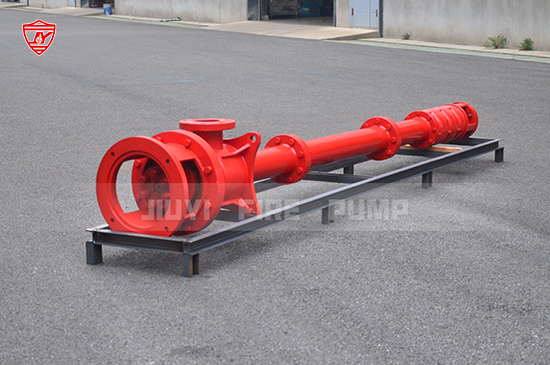
Depending on the project, suitable configurations may include horizontal split case fire pumps, end suction fire pumps, vertical turbine fire pumps, vertical in-line pumps, or other approved fire pump designs.
The required hydraulic head does not by itself determine whether the pump should use an electric motor or diesel engine.
The driver must be selected after the hydraulic requirements are established.
An electric fire pump requires a suitable electrical supply and compatible fire pump controller.
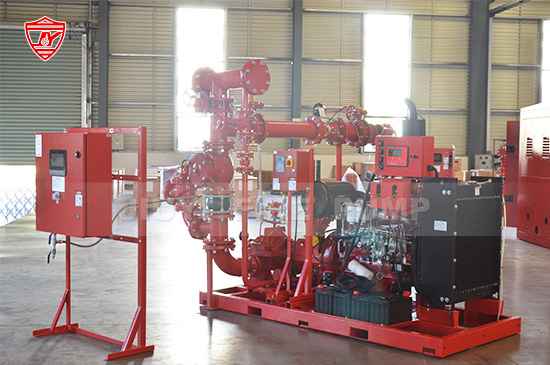
A diesel fire pump requires an appropriately rated diesel engine together with batteries, fuel supply, cooling, exhaust, ventilation, and controller systems.
For projects requiring greater redundancy or independent power sources, electric and diesel fire pumps may be used together as part of a complete fire pump system.
One common mistake is adding a large, arbitrary pressure margin to the calculated fire pump head.
While appropriate design allowances may be required, simply selecting a much higher-pressure pump is not necessarily better.
Excessive pressure can affect:
Piping
Valves
Sprinklers
Hose equipment
Pressure ratings
System operation
Pump selection
Overall project cost
The correct approach is to follow the applicable design standard, project specification, hydraulic calculation, and authority requirements.
The objective is to select a pump that provides the required performance rather than simply choosing the highest-pressure pump available.
After selecting the fire pump, factory testing provides an important opportunity to verify its hydraulic performance.
A professional fire pump manufacturer should have appropriate testing equipment capable of measuring flow, pressure, speed, and other relevant parameters.
Testing helps verify that the manufactured pump performs according to its specified characteristics before it is shipped to the project site.
For certified fire pump equipment, testing and documentation are particularly important because the equipment may need to comply with specific certification and project requirements.
Before finalizing a fire pump selection, confirm:
Required fire pump flow
Elevation difference
Pipe friction losses
Fitting and valve losses
Required residual pressure
Available suction pressure
Total required pump head
Pump performance curve
Churn pressure
Required driver power
Pump type
Applicable standards
Certification requirements
Installation conditions
Factory testing requirements
These factors provide the foundation for selecting a suitable fire fighting pump.
.jpg)
Calculating fire pump head requirements is an essential part of fire protection system design. The calculation should account for elevation, pipe and fitting friction, required residual pressure, and available suction pressure at the required flow rate.
The basic principle can be summarized as:
Required Pump Head = Static Head + Friction Loss + Required Residual Head - Available Suction Head
However, real-world fire pump selection requires more than a simple formula. The complete hydraulic calculation, pump curve, system pressure limits, applicable fire protection standards, water supply, installation conditions, and driver requirements must all be considered.
For fire pump manufacturers, engineers, contractors, and system designers, accurate hydraulic information is the foundation of reliable equipment selection.
By calculating the required flow and head correctly before selecting the pump, project teams can specify equipment that delivers the required hydraulic performance and integrates effectively with the overall fire protection system.
BETTER Technology Group provides fire pump solutions for a wide range of fire protection applications, including electric fire pumps, diesel fire pumps, jockey pumps, split case pumps, end suction pumps, and vertical turbine fire pumps. Proper hydraulic analysis and factory performance testing help ensure that the selected fire pump is matched to the actual requirements of the project.
.jpg)