In a fire protection system, few performance indicators are as critical as fire pump net pressure. Whether you are designing a new fire pump room, inspecting an existing installation, or troubleshooting pressure irregularities, understanding net pressure is essential for keeping building occupants and assets safe. This article provides a complete, easy-to-follow explanation of fire pump net pressure, including what it is, how it is calculated, why it matters, and how to avoid common mistakes in real-world applications.
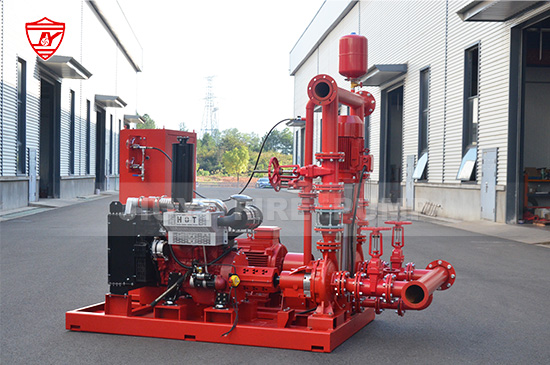
Fire pump net pressure is the difference between the pump’s discharge pressure and suction pressure, measured at the pump itself. It represents the pump’s actual ability to add energy (pressure) to the water as it moves through the fire protection system.
In simple terms:
Net Pressure = Discharge Pressure – Suction Pressure
While this formula looks straightforward, net pressure is often misunderstood or incorrectly evaluated. Many assume that a fire pump’s total discharge pressure reflects its power, but discharge pressure alone cannot reveal the true performance of the pump. Net pressure is the standardized measure used by engineers, inspectors, and manufacturers because it isolates the pump’s contribution without the influence of supply pressure variations.
This is why net pressure is used for the fire pump’s nameplate, acceptance testing, performance curves, and NFPA 20 compliance evaluations.
Don’t confuse net pressure with a fire pump’s rated pressure.
Rated Pressure: The pressure a pump is designed to deliver at its rated flow (e.g., 100 psi at 1000 gpm).
Net Pressure: The actual measured pressure during testing or operation after subtracting suction pressure.
Rated pressure is a constant specification.
Net pressure is a real-time measurement.
A pump can have the correct rated pressure but show abnormal net pressures because of suction fluctuations, installation issues, or system obstructions.
Understanding net pressure is vital for several reasons:
Fire protection systems are designed based on a required pressure at specific flow points. If the pump cannot provide the necessary net pressure, the system may fail to deliver adequate water to sprinklers or hydrants during a fire.
Changes in suction pressure can impact discharge pressure. Monitoring net pressure helps determine whether performance variations are caused by the pump or by the water supply.
NFPA 20 requires that all fire pump acceptance tests document net pressure at multiple flow points. Without net pressure data, the test is incomplete.
Low net pressure can reveal:
Impeller wear
Clogged suction strainers
Air leaks
Blocked pipes
Incorrect pump rotation
Faulty gauges
Excessive net pressure is equally dangerous:
Can cause pipe or fitting failure
Leads to valve and system component stress
Forces pressure relief valve activation
Monitoring net pressure keeps equipment within safe operating limits.
The calculation itself is simple:
Net Pressure = Discharge Pressure – Suction Pressure
However, the challenge lies in ensuring the measurements are accurate, repeatable, and compliant with NFPA standards.
Measure pressure at the discharge gauge on the pump test header or discharge manifold.
Measure pressure at the suction gauge on the pump suction side.
Subtract suction reading from discharge reading.
Verify measurements at churn (0% flow), 100% flow, and 150% flow points.
Compare measured net pressures with the pump’s certified performance curve.
Gauge accuracy is critical. A faulty gauge can produce incorrect pressure differential readings.
Readings must be taken with water flowing through the test header or flow meters.
Suction pressure changes significantly under flow. Be aware of system restrictions or undersized suction piping.
Acceptance testing typically includes three flow points:
At churn, the pump moves no water, so the suction pressure generally remains stable. Net pressure is usually highest at churn because there is no flow loss inside the pump.
At the rated flow point, net pressure must match the pump’s specification.
Example: 100 psi rated pressure at 1000 gpm.
If net pressure significantly deviates from the rating at this point, the pump may not be performing correctly.
At 150% of rated flow, the pump’s net pressure will be lower but must remain within NFPA 20 compliance limits. This test validates the pump’s reliability under maximum demand.
Although the formula for net pressure is simple, many factors can influence the final readings:
A decrease in water supply pressure directly reduces discharge pressure and net pressure.
Undersized suction pipes
Excessive elbows
Long horizontal runs
Poor pump room layout
All can reduce suction pressure during testing.
Worn or eroded impellers reduce the ability to build pressure.
Cavitation occurs when suction pressure drops too low. It damages the impeller and reduces net pressure drastically.
Diesel engine speed problems or VFD malfunctions can lead to reduced pump output.
Air pockets in suction piping create turbulence and reduce pump efficiency.
Foreign materials or corrosion buildup in piping restrict flow.
Because net pressure is sensitive to these operational variables, monitoring it over time is one of the most effective strategies for detecting system deterioration before it becomes dangerous.
Not always. If suction pressure is unusually high, discharge pressure may appear normal while net pressure is low.
Suction pressure is the foundation of net pressure. A change on the suction side will always influence performance.
Raising speed may create dangerous overpressure and mechanical stress. Always find the root cause first.
Even brand-new systems can experience issues from installation errors, piping misalignment, or incorrect gauge placement.
Fire pump pressure and system pressure are different terms and should not be used interchangeably.
Follow guidelines for:
Pipe diameter
Minimal elbows
Shortest practical suction run
Smooth piping transitions
Incorrect rotation is a common cause of low net pressure.
Replace or calibrate pressure gauges regularly, especially before acceptance testing.
Annual flow tests allow comparison of current net pressure with historical performance.
Track municipal or tank supply pressure over time to observe trends.
Clogged strainers may cause rapid suction pressure drops during high-flow tests.
Partially closed valves are a frequent cause of poor performance.
Routine inspection and replacement ensure the pump maintains proper pressure output.
Below are common issues and the corresponding net pressure symptoms:
Possible causes:
Pump rotating in the wrong direction
Worn impeller
Incorrect drive speed
Air leaks in suction lines
High suction losses due to piping design
Possible causes:
Obstruction or restriction in discharge piping
Clogged flow test devices
Weak water supply
Possible causes:
Air entrainment
Unstable water supply
Faulty gauges
Possible causes:
Pump speed too high
Incorrect impeller trim
Error in gauge calibration
Accurate diagnosis begins with precise measurement and comparison to the factory performance curve.
Fire pump net pressure is one of the most important parameters in fire protection engineering. It provides a true picture of pump performance, independent of the water supply, and helps engineers ensure that the system delivers adequate firefighting capability under all conditions.
.jpg)