Construction sites face changing fire protection requirements from the first excavation to project completion. Buildings may have incomplete fire protection systems, temporary power supplies, changing site layouts, stored construction materials, hot work activities, and large numbers of workers and contractors. These conditions can significantly increase fire risk while making permanent fire protection equipment difficult to install or operate.
A containerized fire pump system provides a practical solution for projects that need reliable water-based fire protection before the permanent fire pump room is ready. By integrating fire pumps, drivers, controllers, fuel systems, piping, ventilation, and other necessary components inside a dedicated container, the system can be delivered as a packaged fire protection solution and installed at the construction site with comparatively limited civil work.
For construction companies, EPC contractors, fire protection contractors, and project owners, containerized fire pump systems can provide flexibility without sacrificing the essential performance requirements of a properly engineered fire protection system.
.jpg)
A containerized fire pump system is a fire pump installation assembled inside a purpose-designed enclosure, typically based on a steel shipping-container-style structure or customized equipment container.
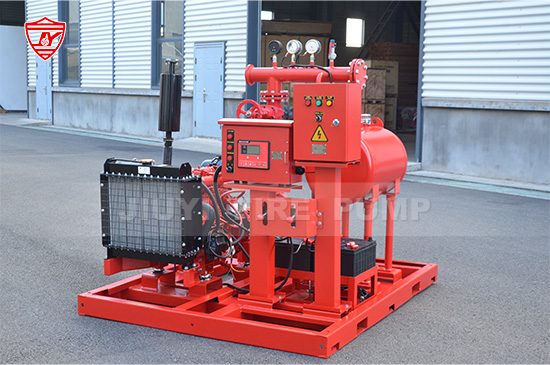
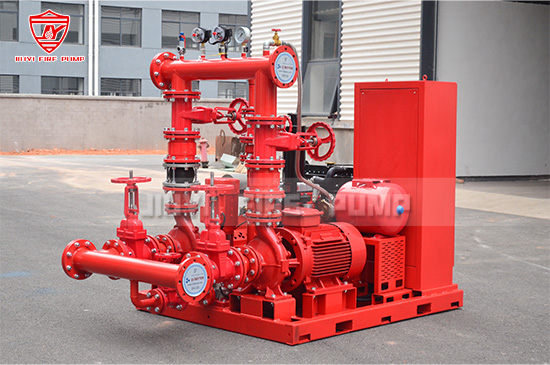
Depending on project requirements, the system can incorporate an electric fire pump, diesel engine fire pump, jockey pump, fire pump controller, diesel fuel tank, batteries, ventilation equipment, exhaust systems, valves, piping, monitoring equipment, and other components.
Instead of constructing a conventional permanent fire pump room immediately, the major fire pump equipment is integrated and tested as a packaged unit before delivery. This approach can simplify transportation, site installation, commissioning, and future relocation.
The exact configuration should always be determined according to the required fire flow, pressure, water source, project conditions, applicable fire codes, and authority requirements.
A construction site is not a static environment. The location of buildings, temporary roads, material storage areas, electrical infrastructure, and fire hazards can change throughout the project.
During early construction, a permanent fire pump room may not yet exist. Even when the building structure is progressing rapidly, the permanent mechanical and electrical systems may still be under construction.
At the same time, fire protection cannot always wait until the final building services are completed.
Construction activities can involve welding, cutting, temporary electrical installations, fuel storage, combustible materials, packaging materials, insulation products, scaffolding, temporary offices, and other potential ignition or fuel sources.
This creates a need for fire protection equipment that can operate effectively under temporary and changing conditions.
A containerized fire pump system addresses this challenge by creating a dedicated location for critical fire pump equipment without requiring the complete permanent building infrastructure to be finished first.
One of the most important advantages of a containerized fire pump system is deployment speed.
A conventional fire pump room may require structural construction, equipment foundations, electrical installation, mechanical piping, ventilation, drainage, fire-rated construction, and multiple stages of coordination.
With a containerized solution, much of the equipment integration can be completed at the manufacturing facility.
The manufacturer can assemble major components, connect internal systems, perform inspections, and conduct factory testing before the equipment is transported to the project site.
After arrival, the installation team can position the container, connect the required water and power systems, complete external piping and electrical connections, and carry out site commissioning.
This can reduce the amount of construction work required specifically for the fire pump installation and help contractors coordinate fire protection with the broader construction schedule.
Construction projects often move through several phases, and fire protection requirements can change as the site develops.
A fire pump system positioned correctly during foundation work may need to serve a different area during structural construction. Temporary facilities may also be relocated as the project expands.
A containerized fire pump can provide greater flexibility than equipment permanently installed in a fixed building room.
Depending on the project design, the container can be relocated or repurposed when the construction phase changes.
This is particularly useful for large industrial developments, infrastructure projects, mining facilities, energy projects, warehouses, commercial developments, and projects where construction takes place across a large site.
However, relocation should not be treated as simply moving a container. The new installation must be reviewed to ensure that pump capacity, suction conditions, discharge pressure, water supply, piping configuration, electrical requirements, and fire protection coverage remain suitable.
Building a dedicated fire pump room can consume valuable construction resources.
A permanent pump room normally requires architectural and structural coordination as well as provisions for ventilation, access, drainage, equipment installation, electrical systems, and maintenance.
For temporary construction applications, investing heavily in permanent infrastructure before the final building is complete may not always be practical.
A containerized fire pump system moves much of the equipment into a dedicated enclosure.
This can reduce the need for constructing a separate temporary pump room and simplify coordination between fire protection equipment and the building's construction schedule.
The container itself can be designed according to project requirements, including access doors, ventilation, lighting, insulation, equipment layout, maintenance space, and environmental protection.
Construction sites can expose mechanical and electrical equipment to dust, rain, wind, temperature changes, and other environmental conditions.
A properly designed containerized fire pump enclosure provides physical protection for critical equipment.
The enclosure can be configured with ventilation and environmental-control features appropriate for the equipment inside. Diesel engine installations, for example, require careful consideration of combustion air, heat removal, exhaust discharge, and ventilation.
The container should therefore be engineered as part of the fire pump system rather than treated simply as a box surrounding the equipment.
For projects located in particularly hot, cold, humid, dusty, or corrosive environments, enclosure design becomes even more important.
Construction projects may have different power conditions depending on the stage of development.
A site may have temporary electrical power, limited electrical capacity, or an unreliable electrical supply during certain phases. In such circumstances, a diesel engine-driven fire pump can provide an independent pumping option when correctly designed and supplied with an appropriate fuel system.
For projects with suitable electrical infrastructure, an electric fire pump can be incorporated into the containerized system.
A complete packaged configuration can also include a main electric fire pump, diesel standby fire pump, and jockey pump.
The jockey pump maintains system pressure during normal conditions and helps prevent unnecessary starting of the main fire pumps due to small pressure fluctuations.
The final pump arrangement depends on the project's hydraulic requirements, applicable standards, available power, water supply, and authority requirements.
Another major benefit of containerized fire pump systems is the opportunity to complete a substantial amount of assembly and inspection before the equipment reaches the construction site.
For a fire pump manufacturer, factory integration allows the pump, driver, controller, piping, valves, fuel system, ventilation components, and other equipment to be checked as a coordinated package.
Factory testing can help identify installation or integration issues before delivery.
For the project owner and contractor, this can provide greater visibility into the equipment configuration before site installation.
Testing requirements should be determined according to the applicable certification, listing, project specification, and fire protection standard. Where listed or approved equipment is required, the complete configuration must be evaluated carefully rather than assuming that individual components automatically make the entire containerized system compliant.
Construction sites frequently have limited available space.
A conventional fire pump room may require a dedicated building area, while a containerized system can be positioned in a designated outdoor location where site conditions permit.
The internal equipment layout can be optimized around pump access, maintenance clearances, ventilation, exhaust, fuel storage, piping, electrical equipment, and operational requirements.
A well-designed layout is especially important because fire pumps are emergency equipment and must remain accessible for inspection, maintenance, testing, and repair.
The container should therefore be sized not only according to the physical dimensions of the equipment but also according to the required working space around each major component.
Containerized fire pump systems can be particularly valuable for remote construction projects.
Infrastructure developments, industrial facilities, mining projects, large-scale agricultural projects, temporary facilities, and projects far from established buildings may require independent fire protection infrastructure.
Transporting individual fire pump components to a remote location and assembling them on site can require significant coordination.
A packaged containerized system can simplify logistics by consolidating major equipment into one transportable unit.
This does not eliminate the need for site preparation. The project still needs an appropriate foundation or support arrangement, water source, suction and discharge connections, electrical or diesel fuel infrastructure, drainage, access, and other necessary services.
Nevertheless, factory integration can simplify the overall installation process.
Construction projects involve many parties, including owners, EPC contractors, mechanical contractors, electrical contractors, fire protection contractors, consultants, and equipment suppliers.
A containerized fire pump system can make equipment responsibilities easier to define because multiple components are integrated into one packaged system.
The manufacturer can provide equipment drawings, dimensions, connection information, component specifications, and testing documentation to support engineering and site planning.
This can help project teams coordinate foundations, access roads, water tanks, external piping, electrical connections, exhaust discharge, fuel supply, and maintenance access before the equipment arrives.
Early coordination is particularly important for large fire pump systems because the required flow and pressure can result in substantial pipe sizes and significant equipment dimensions.
One of the strongest reasons to consider containerized fire pumps for construction is that the equipment can potentially have a second application after the original construction project is completed.
If the system has been designed as a relocatable package, it may be transferred to another construction phase, project, temporary facility, or remote site.
This can make the equipment more adaptable than a permanent installation that becomes part of a completed building.
Before reuse, however, the entire system should be evaluated against the requirements of the new application. Pump performance, system demand, water supply, pressure, environmental conditions, certifications, electrical characteristics, fuel storage, and applicable regulations may differ between projects.
Selecting a containerized fire pump should begin with the fire protection requirements rather than the container dimensions.
Important factors include:
Required flow and pressure: Determine the hydraulic demand of the fire protection system and select the pump according to the required duty point.
Water source: Evaluate the capacity, elevation, suction conditions, water temperature, and available pressure of the water supply.
Pump configuration: Determine whether the project requires an electric fire pump, diesel fire pump, jockey pump, or a combination of these.
Power supply: Confirm electrical voltage, frequency, available capacity, starting requirements, and standby power arrangements.
Diesel fuel system: For diesel-driven equipment, consider fuel capacity, accessibility, ventilation, exhaust routing, and applicable requirements.
Container design: Check ventilation, heat dissipation, insulation, access, lighting, drainage, equipment clearance, and environmental protection.
Maintenance access: Operators must be able to inspect, test, maintain, and repair the equipment safely.
Testing and certification: Confirm the required standards, listings, approvals, inspection procedures, and documentation before equipment selection.
Transportation: Consider container dimensions, lifting points, shipping limitations, site access, and installation logistics.
The choice between a containerized system and a conventional fire pump room depends on the project.
A traditional pump room may be preferable for a permanent facility where the building infrastructure is already established and long-term equipment integration is required.
A containerized system can be advantageous where speed, flexibility, temporary operation, remote installation, or relocation are important considerations.
Neither solution should be selected solely based on initial equipment cost. The project team should consider installation time, civil work, logistics, commissioning, maintenance, future reuse, environmental conditions, and compliance requirements.
.jpg)
Construction projects require fire protection solutions that can adapt to changing site conditions while providing dependable performance.
Containerized fire pumps offer a practical approach by combining critical fire pump equipment into a factory-integrated enclosure. They can support faster deployment, flexible installation, reduced temporary construction requirements, improved equipment protection, simplified logistics, and potential future relocation.
For construction companies, EPC contractors, fire protection contractors, and project owners, the key is to select a containerized fire pump based on the actual hydraulic, mechanical, electrical, environmental, and regulatory requirements of the project.
As a fire pump manufacturer, we understand that every construction project has different requirements. From electric and diesel fire pumps to jockey pumps and complete containerized fire pump systems, proper engineering and factory testing are essential for creating a reliable fire protection solution.
A well-designed containerized fire pump is not simply a fire pump placed inside a container. It is an integrated fire protection system engineered around the project's water supply, fire demand, operating environment, installation conditions, maintenance requirements, and applicable standards.