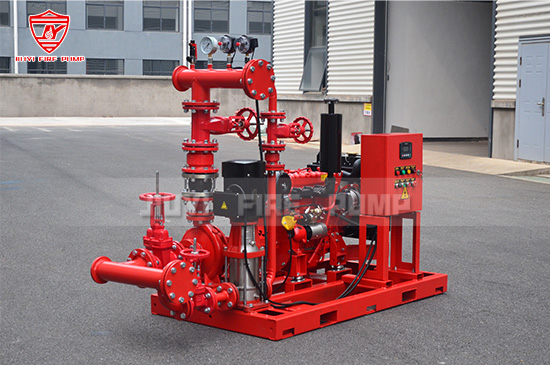
A containerized fire pump is a complete fire protection pumping system installed inside a specially designed container. It combines the fire pump, driver, controller, piping, valves, fuel system, ventilation, exhaust, monitoring equipment, and other necessary components into a protected and transportable package.
Unlike a conventional fire pump room, where individual components are installed and connected at the project site, a containerized fire pump system is assembled and tested in a controlled manufacturing environment before delivery. This approach can simplify installation, reduce on-site construction work, and provide a practical solution for projects where a permanent pump room is difficult or expensive to build.
Containerized fire pump systems are commonly considered for industrial facilities, warehouses, oil and gas facilities, infrastructure projects, remote sites, temporary facilities, agricultural applications, and other locations where reliable fire water supply is essential.
.jpg)
A containerized fire pump system is more than simply putting a fire pump inside a shipping container. It is an engineered fire protection package designed around the requirements of the specific project.
A typical system may include a main electric fire pump or diesel engine fire pump, jockey pump, fire pump controllers, suction and discharge piping, valves, pressure gauges, fuel tank, batteries, ventilation system, exhaust system, lighting, fire and safety monitoring equipment, and auxiliary components.
The container itself is modified to provide the environment required for the equipment. Depending on the application, it may include ventilation openings, louvers, fans, insulation, heating or cooling equipment, lighting, drainage, access doors, maintenance space, and acoustic or thermal protection.
The complete arrangement is normally designed around the required fire pump capacity, local environmental conditions, applicable fire protection standards, and the available water source.
The operating principle is similar to that of a conventional fire pump installation.
When the fire protection system detects a drop in water pressure, the jockey pump may operate first to compensate for small pressure losses. If the pressure continues to fall because water is being discharged through sprinklers, hydrants, hose stations, or another fire protection system, the main fire pump starts.
For systems using a diesel engine fire pump, the engine provides mechanical power to drive the pump. For electric fire pumps, an electric motor provides the required power.
The pump draws water from a dedicated water source, such as a storage tank, reservoir, or other approved supply, and delivers it into the fire protection distribution network at the required pressure and flow.
In a containerized system, the equipment required for this process is arranged within the container. The goal is to create a functional and maintainable fire pump room in a factory-built package.
The exact configuration depends on the project, but a containerized fire pump package commonly includes several major components.
The main fire pump provides the required flow and pressure for the fire protection system. Depending on project requirements, this may be an electric fire pump, diesel engine fire pump, horizontal split-case pump, end-suction pump, vertical turbine pump, or another suitable fire pump configuration.
Pump selection should be based on the required duty point, water source, suction conditions, system pressure, flow requirements, and applicable standards.
For applications where an independent power source is required or where electrical power may not be sufficiently reliable, a diesel engine fire pump can be used.
A diesel-powered system normally requires additional equipment, including batteries, a fuel tank, engine controls, exhaust piping, ventilation, and monitoring systems.
The jockey pump maintains pressure in the fire protection piping system when there is no significant water demand.
It is generally smaller than the main fire pump and is designed to handle relatively small pressure losses. By maintaining system pressure, it helps prevent unnecessary starting of the main fire pump.
The controller provides the starting and monitoring functions for the fire pump. The configuration depends on whether the system uses an electric motor or diesel engine.
For a complete fire pump package, controller selection should be coordinated with the pump, driver, power supply, control requirements, and applicable project standards.
A containerized fire pump system can include factory-installed suction and discharge piping, isolation valves, check valves, test connections, pressure gauges, and other required components.
Factory assembly allows the manufacturer to control the arrangement and verify connections before the system reaches the project site.
Diesel-powered containerized fire pump systems require a suitable fuel storage and supply arrangement. The fuel tank capacity, location, piping, monitoring, and accessibility should be designed according to the project requirements and applicable regulations.
Diesel engines generate heat and exhaust gases. Proper ventilation is therefore an important part of a containerized diesel fire pump system.
The design must provide sufficient airflow for engine operation and heat removal while safely directing exhaust gases away from the container and surrounding areas.
Depending on the project, the container can incorporate temperature monitoring, fire detection, emergency lighting, alarms, ventilation controls, fuel level monitoring, and other safety systems.
The equipment selected should correspond to the operating environment and applicable fire protection requirements.
One of the main advantages is installation flexibility.
Traditional fire pump installations generally require a dedicated building or fire pump room. This can involve civil construction, structural work, electrical installation, ventilation, piping, drainage, and other site activities.
A containerized fire pump system integrates much of this work into a factory-built package.
This can be particularly useful when a project has limited construction space or when establishing a permanent pump room is impractical.
Another advantage is factory assembly. Instead of installing every component individually at the project site, the manufacturer can assemble the system under controlled conditions. This can improve consistency and reduce the amount of field assembly required.
Transportation is another important benefit. A containerized system can be designed for transportation as a single package, making it suitable for remote projects and locations where construction resources are limited.
Containerized fire pump systems can be used across a wide range of applications.
Factories, processing plants, manufacturing facilities, and industrial sites may require dedicated fire water pumping equipment. A containerized solution can provide a practical alternative when there is insufficient space for a conventional pump house.
Large warehouses often require substantial fire protection water flow. Depending on the site layout and local requirements, a containerized fire pump may be positioned near the fire water storage tank and connected to the building's fire protection network.
Oil and gas facilities often have demanding fire protection requirements and may be located in remote or harsh environments. Containerized systems can consolidate fire pump equipment and supporting systems into a protected package.
Construction sites, mining operations, infrastructure projects, and temporary facilities may need reliable fire protection without constructing a permanent pump building.
A containerized fire pump can be transported to the site and connected to the water source and fire protection network.
Large agricultural facilities and irrigation projects may also require dedicated pumping equipment. Where fire protection and other water applications need to be considered together, the system configuration must be carefully engineered for the intended duty.
The main difference is the method of installation.
A conventional fire pump room is constructed as part of the project. Pumps, controllers, piping, valves, ventilation, electrical systems, and other equipment are installed within the building.
A containerized fire pump system incorporates these functions into a prefabricated enclosure.
This does not automatically mean that a containerized system is suitable for every project. The decision should consider local regulations, fire protection standards, environmental conditions, maintenance requirements, access requirements, transportation limitations, and the available installation area.
For projects with a suitable layout and clear engineering requirements, a containerized system can significantly simplify the overall installation process.
Selecting the correct system requires more than choosing a container size.
First, the required fire pump duty should be established. The design flow rate and pressure are fundamental parameters for pump selection.
The water source must also be evaluated. Suction conditions, water level, available pressure, pipe arrangement, and the distance between the water source and pump all affect the system design.
The power source is another important consideration. Depending on the project, an electric motor fire pump, diesel engine fire pump, or combination of different fire pump arrangements may be required.
Environmental conditions should also be considered. Projects in cold climates may require heating and insulation, while hot climates may require additional ventilation or cooling. Coastal and corrosive environments may require appropriate material and coating selections.
Maintenance access is equally important. Operators need sufficient space to inspect the engine, pump, controller, valves, batteries, fuel system, and other components.
Transportation should be considered from the beginning of the design. The overall dimensions, weight, lifting points, shipping requirements, and site access can affect the final container configuration.
A containerized fire pump system is generally a packaged pumping solution rather than the entire fire protection system for a facility.
The complete fire protection system may also include water storage tanks, sprinkler systems, hydrants, hose reels, fire department connections, fire detection systems, alarm systems, and fire protection piping.
The containerized fire pump provides the pressure and flow required to supply the relevant fire protection network.
Therefore, the pump package should always be designed as part of the overall fire protection system rather than as an isolated piece of equipment.
Factory testing is an important advantage of a professionally manufactured containerized fire pump system.
Because many components are assembled before shipment, the manufacturer can inspect the installation, verify equipment operation, check piping connections, test controls, and identify potential issues before the package reaches the project site.
For complex systems, factory testing can help reduce commissioning work after installation.
The testing program should be determined according to the project specifications and applicable standards. Where certification or listing requirements apply, the pump, driver, controller, and complete arrangement should be evaluated according to the relevant requirements.
A containerized fire pump should be maintained with the same attention given to a conventional fire pump installation.
Regular inspection should cover the pump, driver, controller, valves, gauges, batteries, fuel system, ventilation equipment, exhaust system, and other critical components.
For diesel engine systems, fuel quality, battery condition, engine fluids, cooling systems, exhaust components, and starting systems require particular attention.
The container itself should also be inspected. Doors, ventilation openings, lighting, drainage, insulation, and environmental protection should remain functional.
A well-designed maintenance layout is therefore an important part of the original containerized fire pump design.
.jpg)
A containerized fire pump is a specialized engineered package that combines fire pump technology with enclosure design, piping, controls, ventilation, fuel systems, and project-specific requirements.
For a manufacturer, the challenge is not simply to install a pump inside a container. The complete package must be designed so that the equipment can operate reliably, remain accessible for maintenance, withstand the intended environment, and meet the applicable project requirements.
As a fire pump manufacturer, Better Technology Group can develop containerized fire pump solutions around different fire pump configurations and project requirements. Depending on the application, the package can integrate electric fire pumps, diesel engine fire pumps, jockey pumps, controllers, piping, valves, fuel systems, ventilation, exhaust systems, and monitoring equipment.
For projects where construction space is limited, installation needs to be simplified, or fire pump equipment must be deployed in remote locations, a containerized fire pump can provide a practical and highly integrated approach.
The most important step is to define the required flow, pressure, water source, power supply, environmental conditions, applicable standards, installation location, and maintenance requirements before finalizing the system design. With these parameters clearly established, the containerized fire pump can be engineered as a complete and reliable part of the project's fire protection infrastructure.
.jpg)