Selecting the correct fire pump capacity is one of the most important steps in designing a reliable fire protection system. A fire pump must provide sufficient water flow and pressure to meet the hydraulic demand of the system, but selecting a pump that is unnecessarily large can also create installation, cost, and operational challenges.
For fire protection engineers, contractors, consultants, and project owners, fire pump capacity should be determined from the actual requirements of the fire protection system rather than simply choosing a pump based on building size or a standard pump rating.
The correct fire pump capacity depends on several factors, including required flow, discharge pressure, elevation, pipe friction losses, water supply conditions, system demand, applicable standards, and the type of fire protection equipment being supplied.
This guide explains the key factors involved in fire pump sizing and how to select an appropriate pump capacity for different fire protection projects.
.jpg)
Fire pump capacity generally refers to the amount of water a fire pump can deliver at a specified pressure.
Two of the most important parameters are:
Flow rate: The volume of water delivered by the pump, commonly expressed in GPM or LPM.
Pressure: The pressure or head produced by the pump, commonly expressed in PSI, bar, kPa, meters, or feet of head.
For example, a fire pump may be specified to provide 1,000 GPM at a particular pressure. This does not mean that the pump will produce the same pressure at every flow condition. The actual relationship between flow and pressure is represented by the pump performance curve.
Therefore, when selecting fire pump capacity, engineers should consider both flow and pressure rather than looking at the flow rating alone.
A fire pump is a critical component of a fire protection system. Its purpose is to provide the water supply required by the system under fire conditions.
If the selected pump capacity is insufficient, the system may not achieve the required pressure or flow at the most hydraulically demanding point.
An oversized pump can also create problems. Excessive pressure may require additional pressure management, increase equipment costs, affect system components, and result in an inefficient solution.
Correct fire pump sizing helps ensure that the pump:
Provides the required water flow
Maintains the required system pressure
Meets the hydraulic demand of the system
Works correctly with the available water supply
Is compatible with the piping and fire protection equipment
Meets applicable project standards
Can operate reliably under the expected conditions
The goal is not simply to select the biggest pump. The goal is to select a pump whose performance matches the requirements of the fire protection system.
The first major step in determining fire pump capacity is establishing the required fire flow.
Fire protection systems can include sprinklers, standpipes, hydrants, hose stations, water spray systems, foam systems, and other water-based suppression equipment.
Each application may have different hydraulic requirements.
The required flow should be determined from the project design and applicable fire protection requirements. Hydraulic calculations should identify the demand of the system and determine the flow required at the pump.
For example, a small commercial building may have a substantially different fire water demand from a large warehouse, manufacturing facility, high-rise building, or industrial plant.
Building size alone is therefore not a sufficient basis for selecting fire pump capacity.
The duty point is one of the most important concepts in fire pump selection.
The fire pump duty point represents the required combination of flow and pressure at which the pump must operate to satisfy the system demand.
For example, a project may specify a duty point of:
1,000 GPM at 120 PSI
This means the selected pump should be capable of delivering approximately 1,000 gallons per minute while providing the required pressure under the specified operating conditions.
The pump performance curve should then be reviewed to verify that the selected pump can meet the required duty point.
A proper selection should not rely solely on the nominal capacity printed on the pump nameplate. The actual pump curve must be considered.
Flow determines how much water the system needs, while pressure determines whether the water can reach the required locations with sufficient pressure.
The required pump pressure may need to overcome several components:
Elevation difference
Pipe friction losses
Fitting losses
Valve losses
Equipment losses
Required pressure at the most remote sprinkler or outlet
Required pressure at hydrants or standpipes
Pressure requirements of specialized suppression systems
For a building with multiple floors, elevation can have a significant effect on the required pump pressure.
As water rises vertically, additional pressure is required to overcome the elevation head. Therefore, a pump serving a high-rise building may require substantially more pressure than a pump serving a single-story facility with similar flow requirements.
Total dynamic head, commonly abbreviated as TDH, is another important factor in fire pump sizing.
TDH represents the total head that the pump needs to provide to overcome the hydraulic resistance of the system and deliver the required pressure at the point of demand.
It may include:
Static elevation head
Friction losses in piping
Fitting and valve losses
Equipment losses
Required residual pressure
The pump capacity should be selected based on the hydraulic calculation of the complete system.
For this reason, fire pump sizing should be performed using project-specific hydraulic information rather than relying on general assumptions.
The available water supply must also be evaluated before selecting the fire pump.
A fire pump may take suction from:
Municipal water supply
Dedicated fire water tank
Ground-level reservoir
Underground water storage
Elevated water source
Other approved water supplies
The available suction pressure and flow can affect the required pump configuration.
For example, if the water source is located below the pump and the water level varies significantly, a vertical turbine fire pump may be considered for the application.
The designer should evaluate the water source, tank dimensions, water levels, suction conditions, and piping arrangement together with the fire pump.
Fire pump capacity and driver power are related but are not the same specification.
Pump capacity primarily describes the required flow and pressure performance.
Motor power, on the other hand, refers to the power required to drive the pump under the specified operating conditions.
Once the pump performance has been determined, the required driver power can be established based on the pump efficiency, flow, head, and operating conditions.
For an electric fire pump, the motor must have sufficient power for the selected pump.
For a diesel fire pump, the diesel engine must also be properly matched to the pump across the required operating range.
Choosing motor power first and then attempting to match a pump around it is generally not the correct approach. The hydraulic requirements should drive the pump selection, and the appropriate driver should then be selected to operate the pump.
Fire pump capacity is also influenced by the type of pump selected.
Different pump configurations are suitable for different applications.
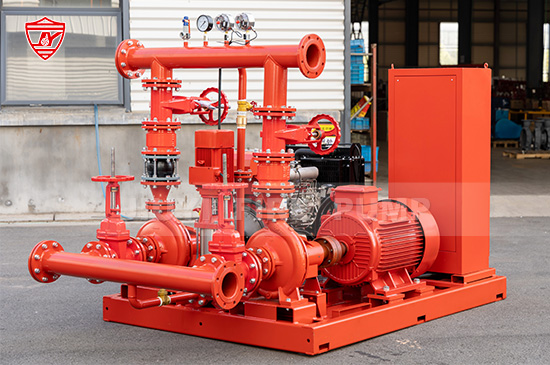
Horizontal split case pumps are widely used for medium- and high-flow fire protection applications. They are commonly selected for industrial facilities, commercial buildings, warehouses, and other large systems.
Their construction can provide convenient access for maintenance and is well suited to applications requiring substantial water flow.
End suction fire pumps are commonly used for applications with more moderate flow requirements and where a compact arrangement is beneficial.
They can be suitable for many commercial and building fire protection applications when the required duty point falls within the pump's performance range.
Vertical turbine pumps are particularly useful when the water source is below the pump and the system requires water to be lifted from a tank, reservoir, or other low-level source.
They are commonly considered for large water supplies and applications where conventional horizontal suction arrangements are unsuitable.
A jockey pump is not normally used to provide the main fire flow. Instead, it maintains system pressure and compensates for relatively small pressure losses.
The jockey pump therefore has a much smaller capacity than the main fire pump.
Correct sizing of both the main fire pump and jockey pump is important for proper system operation.
The required fire pump capacity depends heavily on what the pump is supplying.
A sprinkler system, standpipe system, hydrant system, water spray system, or combined system may have different hydraulic requirements.
In some projects, multiple water-based systems may operate simultaneously according to the applicable design criteria.
The hydraulic calculation should identify the most demanding operating scenario that the fire pump is expected to support.
This is particularly important in industrial facilities where fire protection systems may involve multiple hazards, large storage areas, process equipment, or special suppression arrangements.
Once the required flow and pressure have been established, the manufacturer's pump curve should be reviewed.
The pump curve shows how pressure or head changes as the flow rate changes.
Important points to examine include:
Rated flow
Rated pressure
Shutoff pressure
Performance at different flow rates
Maximum operating conditions
Driver power requirements
The pump should provide suitable performance at the required duty point and within the applicable requirements for the project.
Looking only at the rated flow without reviewing the complete pump curve can result in an incorrect selection.
Fire pump capacity cannot be considered independently from applicable standards.
Depending on the project location and specification, the fire pump may need to comply with requirements such as NFPA 20, UL certification, FM approval, CE requirements, or local fire protection regulations.
Some projects may specifically require UL Listed or FM Approved equipment.
The required certification should be confirmed before selecting the pump because certification requirements can affect the available pump models, drivers, controllers, accessories, and performance requirements.
Project specifications should always be reviewed carefully to determine the required standards and certification scope.
Oversizing a fire pump may appear to provide additional safety, but simply selecting a much larger pump is not always the correct solution.
An excessively large pump can produce higher system pressure than required. This can affect valves, piping, fittings, sprinklers, and other system components.
It may also increase the required motor or diesel engine size and increase the overall equipment footprint and project cost.
The objective should be to provide the required fire flow and pressure with an appropriate safety margin while remaining consistent with the applicable design standard and project specifications.
Undersizing presents a different problem.
If the fire pump cannot provide the required flow and pressure, the fire protection system may not perform as intended during a fire event.
Common causes of undersizing include:
Using building size instead of hydraulic calculations
Ignoring elevation
Underestimating friction losses
Using incorrect pipe information
Failing to account for the most demanding system area
Selecting a pump based only on flow
Not checking the actual pump curve
Accurate hydraulic calculations and careful review of the pump performance curve are therefore essential.
The required pump capacity also affects the selection of the driver.
Electric fire pumps are commonly used where a suitable electrical power supply is available. The motor must provide adequate power for the selected pump throughout its required operating range.
Diesel fire pumps provide an alternative or additional source of pump drive, particularly where project requirements call for an independent driver.
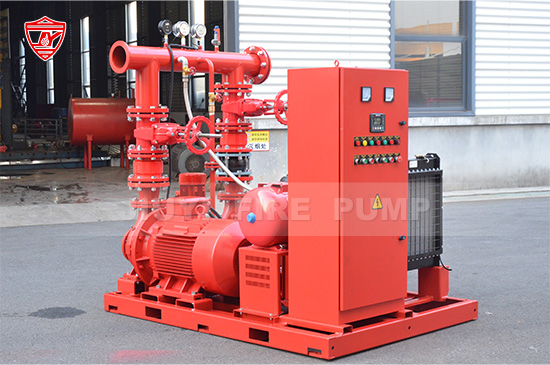
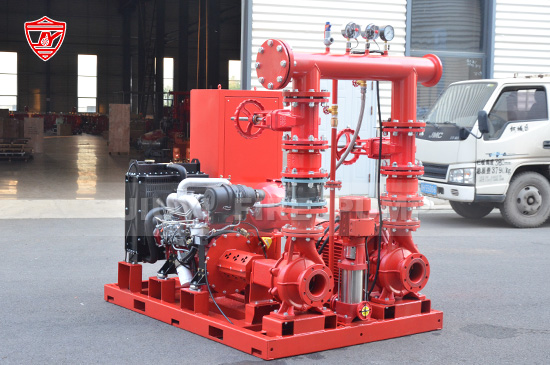
For a diesel fire pump, the complete system may include the diesel engine, controller, batteries, fuel tank, cooling system, exhaust system, and associated accessories.
The pump and driver should be engineered as a compatible package rather than selected independently.
Performance testing provides an important quality check before a fire pump is delivered to the project.
A professional fire pump manufacturer should have appropriate testing capabilities to verify pump performance against the required operating conditions.
Testing can help confirm:
Flow performance
Pressure performance
Driver operation
Controller operation
Overall package performance
For major fire protection projects, factory testing requirements should be established during the procurement stage.
When requesting a fire pump quotation, providing complete technical information can significantly improve the accuracy of the selection.
Useful information includes:
Required flow rate
Required pressure
Pump duty point
Hydraulic calculation
Static and residual pressure
Water source information
Suction conditions
Pump installation elevation
Pump room dimensions
Available electrical supply
Diesel requirements, if applicable
Required certification
Applicable standards
Project location
Environmental conditions
Required accessories
Delivery schedule
The more complete the project information, the easier it is for the manufacturer to recommend an appropriate fire pump capacity.
Before approving a fire pump selection, verify the following:
Required system flow has been established.
Required pressure has been calculated.
Total dynamic head has been determined.
Water source conditions have been evaluated.
The pump duty point has been identified.
The manufacturer's pump curve has been reviewed.
The pump type is suitable for the application.
The driver has sufficient power.
Applicable standards have been identified.
Required certifications have been confirmed.
The pump is not unnecessarily oversized.
The pump is not undersized for the hydraulic demand.
Installation conditions have been considered.
Factory testing requirements have been defined.
.jpg)
Selecting the right fire pump capacity is fundamentally a hydraulic design decision. The correct pump must provide the required flow and pressure at the project's duty point while working reliably with the available water supply and the rest of the fire protection system.
The process should begin with hydraulic calculations and system demand. From there, engineers can determine the required flow, total dynamic head, pump type, driver power, certification, and overall fire pump configuration.
Whether a project requires a horizontal split case fire pump, end suction fire pump, vertical turbine fire pump, electric fire pump, diesel fire pump, or complete fire pump set, the selected equipment should be matched to the actual requirements of the project.
For fire pump manufacturers, accurate project information is the foundation of proper selection. By combining hydraulic calculations, verified pump curves, appropriate standards, factory testing, and engineering experience, project teams can select fire pump capacity that meets the needs of the fire protection system without unnecessary oversizing or performance limitations.
A correctly sized fire pump is not simply a pump with a high flow rating. It is a pump that delivers the required flow and pressure, at the required duty point, under the conditions for which the fire protection system was designed.