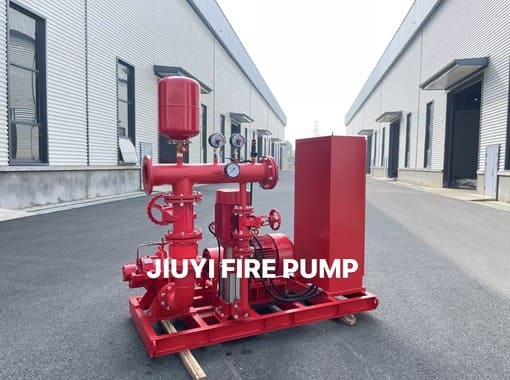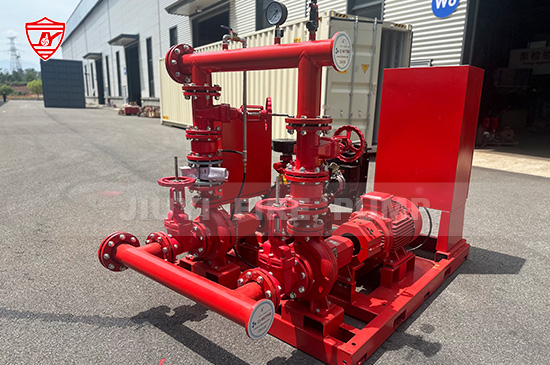
Determining the required fire pump pressure involves evaluating flow demand, elevation, friction loss, system pressure requirements, and fire protection design criteria. This guide explains how to calculate fire pump pressure and select a suitable fire pump for reliable fire protection systems.
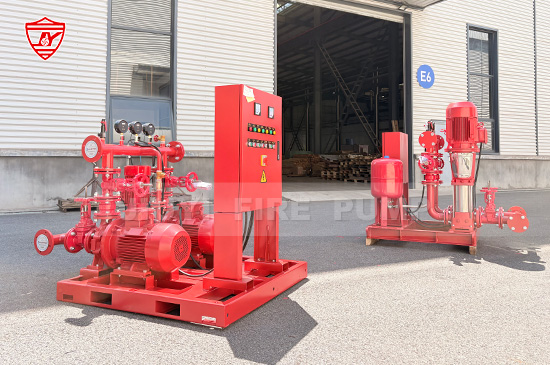
Selecting the correct fire pump is one of the most important decisions when designing a fire protection system. A fire pump must deliver enough water at the required pressure to ensure that sprinklers, hydrants, standpipes, hose stations, and other fire protection equipment can operate effectively during an emergency.
One of the most common questions asked by building owners, fire protection contractors, engineers, and system designers is: How do you determine the required fire pump pressure?
The answer is not simply choosing the highest-pressure pump available. An oversized or incorrectly selected pump can create unnecessary costs, excessive system pressure, and potential equipment problems. On the other hand, a pump that cannot provide sufficient pressure may fail to meet the hydraulic demand of the fire protection system.
The correct approach is to determine the system's required flow and pressure based on the hydraulic design and then select a fire pump that can meet those requirements under the applicable fire protection standards.
This article explains the key factors involved in determining required fire pump pressure and provides a practical framework for fire pump selection.
Fire pump pressure is the pressure that a fire pump generates to move water through a fire protection system. It is typically discussed in terms of pressure at the pump discharge, often measured in psi, bar, kPa, or meters of water head.
However, the pressure required at the fire pump is not necessarily the same as the pressure required at the most remote sprinkler or hose outlet.
As water travels through the system, pressure is lost because of:
The fire pump must provide sufficient pressure to overcome these losses while still delivering the minimum pressure required at the hydraulically most demanding point in the system.
This is why fire pump pressure should always be determined as part of the overall hydraulic calculation rather than selected independently.
The basic concept for determining required fire pump pressure is:
Required Fire Pump Pressure = Required System Pressure + Pressure Losses + Elevation Loss − Available Suction Pressure
This calculation provides a practical starting point for determining the pressure that the fire pump needs to supply.
The four major factors are:
Each factor can have a significant impact on the final fire pump selection.
Before determining pump pressure, the required fire flow must be established.
Fire protection systems are designed around both flow and pressure. The pump must be capable of supplying the required water flow at the required pressure.
The required flow may depend on the type of fire protection system and the application. For example, a system may include:
The hydraulic demand is generally determined by the most demanding fire protection area or scenario identified in the system design.
For example, suppose a fire protection system requires a flow of 1,000 gallons per minute. The fire pump must be selected based on its ability to deliver this flow while maintaining the pressure required by the system.
A pump that provides high pressure but insufficient flow is not suitable. Likewise, a pump with adequate flow but insufficient pressure cannot meet the system demand.
Therefore, flow and pressure must always be considered together when selecting a fire pump.
The next step is to determine the minimum pressure required at the most hydraulically demanding point of the system.
This point is often located at the most remote sprinkler, standpipe outlet, or hose connection. It may also be located at a higher elevation or in an area with significant hydraulic resistance.
The required pressure depends on the type of fire protection equipment being supplied and the design criteria of the system.
For sprinkler systems, the required pressure is influenced by the sprinkler's minimum operating pressure and the required discharge density or flow.
For standpipe systems, the required pressure at hose connections must be considered.
The key principle is that the fire pump must provide enough pressure so that the required pressure remains available at the most demanding point after accounting for all hydraulic losses.
Water loses pressure as it flows through pipes. This is known as friction loss.
The amount of friction loss depends on several factors, including:
Smaller pipes generally create greater friction losses than larger pipes when carrying the same flow.
As flow increases, friction losses also increase. This means that a fire pump designed for a high-flow application may require significantly more pressure than a pump serving a smaller system.
Hydraulic calculations typically account for friction loss in the main piping, branch lines, fittings, valves, and other components.
For accurate fire pump sizing, the entire flow path from the pump discharge to the most demanding outlet should be evaluated.
Elevation is another major factor in determining required fire pump pressure.
When water must be pumped to a higher elevation, additional pressure is required. This is particularly important in:
As a general engineering approximation, every 10 meters of elevation difference requires approximately 0.98 bar of additional pressure. In U.S. customary units, approximately 0.433 psi is required for every foot of elevation gain.
For example, if a fire pump must supply water to equipment located 30 meters above the pump, the system will require approximately 2.94 bar of additional pressure simply to overcome the elevation difference.
This pressure must be added to the pressure required at the remote point and the friction losses throughout the piping system.
Ignoring elevation can result in a fire pump that appears adequate at ground level but cannot provide sufficient pressure at the highest or most remote point of the system.
The available water supply is another critical consideration.
A fire pump does not always operate from a zero-pressure water source. In many installations, the pump receives water from:
If the water supply already provides some pressure, this available pressure can contribute to the total pressure required by the system.
For example, if the hydraulic calculation indicates that the system requires 10 bar at the pump discharge but the water supply can reliably provide 3 bar at the pump suction, the pump may need to add approximately 7 bar of pressure, subject to the complete hydraulic design.
However, the available water supply must be evaluated carefully. Static pressure and residual pressure are not the same.
Static pressure is measured when there is little or no flow. Residual pressure is the pressure available while water is flowing.
Fire protection systems should be evaluated under the expected flow conditions, because the water supply pressure may decrease significantly when demand increases.
A fire pump's rated pressure is the pressure the pump is designed to provide at its rated flow.
For example, a fire pump may be rated at:
The pump must be evaluated based on its complete performance curve rather than its rated point alone.
Fire pumps are generally capable of operating across a range of flow conditions. Therefore, the pump performance curve should be checked against the system demand to ensure that the selected pump operates within the required performance range.
When selecting a pump, engineers should consider the relationship between:
The pump curve provides valuable information about how the pump will perform under different operating conditions.
Churn pressure, also known as shutoff pressure, is the pressure produced by the pump when there is no water flow through the discharge.
This is an important consideration because system pressure can increase significantly when the fire pump starts but there is little or no flow.
A pump may have a rated pressure of 100 PSI at its rated flow, but its churn pressure may be higher.
The system components, including pipes, valves, fittings, and other equipment, must be capable of handling the pressure that can occur during operation.
This is one reason why fire pump selection should not be based solely on the rated discharge pressure.
The fire pump performance curve is one of the most important documents for selecting and evaluating a fire pump.
A typical fire pump curve shows the relationship between flow and pressure.
The curve can help engineers determine:
The system demand point should be compared with the pump curve to verify that the pump can meet the required flow and pressure.
For example, if a hydraulic calculation indicates that a system requires 1,000 GPM at 120 PSI, the selected pump should be capable of delivering at least this performance at the required operating condition.
The pump curve should also be evaluated against the applicable fire protection standard and project requirements.
Fire pump pressure should be determined according to the applicable codes, standards, and local regulations.
For many commercial and industrial fire protection systems, NFPA 20 is an important reference for the selection and installation of stationary fire pumps.
However, the applicable requirements can vary depending on:
In addition to NFPA 20, other standards may apply to sprinklers, standpipes, fire hydrants, water supplies, and testing.
It is important to distinguish between fire pump performance requirements and system hydraulic design requirements. NFPA 20 provides requirements for fire pump installation and performance, while other standards and hydraulic calculations determine the actual water demand of the fire protection system.
Professional fire protection engineers should review the complete system design and applicable requirements before selecting the final pump.
Consider a simplified example.
A fire protection system has the following requirements:
Using the basic calculation:
Required Fire Pump Pressure = 7 + 1.5 + 2 − 2
The required additional pump pressure is approximately 8.5 bar.
The pump would then need to be selected based on the required flow at approximately 8.5 bar of additional pressure, while also considering the complete pump curve, churn pressure, available water supply, and applicable standards.
This is a simplified example. Actual fire pump hydraulic calculations are more detailed and should account for the complete piping network and all relevant components.
One common mistake is selecting a pump based only on pressure.
A fire pump is a flow-and-pressure device. Both parameters must be considered simultaneously.
Another mistake is ignoring elevation. A system that works well at ground level may not provide sufficient pressure on upper floors.
Failing to account for friction loss is another common problem. Long pipelines and complex piping networks can create significant pressure losses.
It is also important not to rely solely on static water supply pressure. The available residual pressure under flow conditions is usually more relevant to hydraulic system performance.
Finally, selecting a pump with excessive pressure can also be problematic. Overpressurizing the system may require additional pressure-reducing equipment and can increase system costs.
The correct fire pump should be selected after completing a hydraulic analysis of the fire protection system.
The basic selection process includes:
The final pump selection should provide sufficient flow and pressure without creating unnecessary excess pressure.
The hydraulic calculation is only one part of a successful fire protection project. The quality and reliability of the fire pump itself are equally important.
A qualified fire pump manufacturer should be able to provide accurate pump performance data, technical documentation, testing information, and appropriate certification for the intended application.
Depending on project requirements, customers may need electric fire pumps, diesel engine fire pumps, jockey pumps, vertical turbine pumps, end suction pumps, or split case fire pumps.
For projects requiring certified equipment, customers should also verify that the selected pump and associated components meet the required certification and approval requirements.
A reliable manufacturer should also be able to support customers with pump selection, performance curves, technical specifications, and documentation required for project approval.
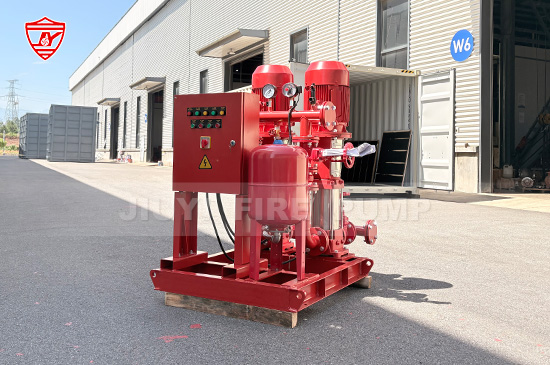
Determining the required fire pump pressure is a critical step in designing a reliable fire protection system. The correct pressure cannot be determined by looking at the pump alone. It must be calculated based on the complete hydraulic requirements of the system.
The most important factors include required flow, minimum pressure at the most demanding point, friction loss, elevation, available water supply pressure, and fire pump performance characteristics.
A properly selected fire pump should deliver the required flow at the required pressure while operating within the applicable performance and system requirements.
For fire protection engineers, contractors, consultants, and system integrators, understanding these principles makes it easier to select the right fire pump and avoid common sizing mistakes. Whether the project requires an electric fire pump, diesel engine fire pump, jockey pump, or a complete fire pump set, accurate hydraulic calculations and careful evaluation of pump performance are essential for dependable fire protection.