In fire protection engineering, few concepts are more misunderstood than head and pressure. These two terms are often used interchangeably in everyday conversation, yet they represent fundamentally different physical quantities. Misunderstanding the difference can lead to incorrect pump selection, underperforming systems, or even failure to meet code requirements.
For professionals working with fire pump systems—whether engineers, contractors, or facility managers—understanding the difference between fire pump head and pressure is essential for proper system design, performance evaluation, and compliance with standards such as National Fire Protection Association and its NFPA 20.
This article explains the difference between fire pump head and pressure, how they relate to each other, how to calculate them, and why both are critical in fire protection systems.
Head refers to the height to which a pump can raise water. More precisely, it is the amount of energy per unit weight that the pump imparts to the fluid. Head is measured in feet (ft) or meters (m).
The key concept is that head is independent of the liquid’s density. Whether you are pumping water at sea level or at high altitude, the head generated by the pump remains the same.
In fire protection systems, we commonly refer to Total Dynamic Head (TDH), which includes:
Static head (vertical elevation difference)
Friction loss in pipes
Losses through valves and fittings
Pressure requirements at discharge points
Head is a measure of energy, not force.
Pressure is the force exerted by a fluid per unit area. In fire protection systems, pressure is typically measured in:
PSI (pounds per square inch)
Bar
kPa
Pressure depends on fluid density. For water systems, the relationship between head and pressure is direct and predictable because water density is consistent under normal fire protection conditions.
Unlike head, pressure represents the mechanical force available at a certain point in the system. For example, sprinkler systems require a minimum pressure at the most hydraulically remote point to ensure proper discharge.
The simplest way to understand the difference:
Head = Energy per unit weight (height equivalent)
Pressure = Force per unit area
Head describes what the pump adds to the water in terms of energy.
Pressure describes what the system experiences at a specific location.
Another critical difference:
Head is constant regardless of fluid density.
Pressure changes if fluid density changes.
Because fire pumps almost always move water, the conversion between head and pressure is standardized and widely used in calculations.
For water at standard conditions:
1 psi ≈ 2.31 feet of head
1 bar ≈ 10.2 meters of head
The conversion formula:
Pressure (psi) = Head (ft) ÷ 2.31
Head (ft) = Pressure (psi) × 2.31
Example:
If a fire pump produces 115 psi, the equivalent head is:
115 × 2.31 = 265.65 feet of head
This conversion is essential when reading pump curves or designing fire protection systems.
Pump performance curves are typically expressed in head rather than pressure. There are several reasons for this:
Head is independent of fluid density.
Head provides a universal way to compare pump performance.
Centrifugal pump theory is based on energy transfer, not force.
Fire pumps—whether horizontal split case, end suction, or vertical turbine—are centrifugal pumps. Their performance is defined by head versus flow rate.
Using head ensures consistency in performance evaluation, especially in industrial applications beyond water.
In a real fire pump system, both head and pressure matter.
The pump produces head.
The system experiences pressure.
For example:
The fire pump may be rated at 150 psi at 100% flow.
This rating corresponds to a certain head value.
As water flows through pipes, friction losses reduce pressure.
Elevation changes also affect pressure.
Engineers must ensure that enough pressure remains at the most remote sprinkler or hydrant to meet discharge requirements.
This is why hydraulic calculations are essential in system design.
Total Dynamic Head is one of the most important parameters in fire pump selection. TDH includes:
Static suction lift or head
Static discharge elevation
Friction losses in piping
Required residual pressure at discharge
If TDH is underestimated, the selected fire pump may not deliver sufficient pressure during a fire event.
If TDH is overestimated, the pump may be oversized, leading to excessive pressure, energy waste, and potential system damage.
Proper calculation ensures code compliance and operational reliability.
Fire pump performance curves show the relationship between:
Flow rate (GPM or m³/h)
Head (ft or m)
Efficiency
Power consumption
At 100% rated flow, the pump delivers its rated head.
At 150% rated flow, according to NFPA 20 requirements, the pump must deliver at least 65% of rated pressure.
Understanding how head decreases as flow increases is critical for system safety. During a fire event, demand may exceed rated flow, and the pump must still provide sufficient pressure.
This is why head-based curves are essential tools for engineers.
They are related but not identical. Head measures energy. Pressure measures force.
Not necessarily. Excessive pressure can damage sprinkler heads, valves, and piping. Fire pump systems must be carefully balanced.
Selecting a fire pump based solely on discharge pressure without considering total dynamic head, friction loss, and elevation is a major design error.
Consider a high-rise building:
The highest sprinkler is 200 feet above the pump.
Required pressure at sprinkler: 20 psi.
Friction losses: 30 psi.
Step 1: Convert elevation to pressure
200 ft ÷ 2.31 ≈ 86.6 psi
Step 2: Add required sprinkler pressure
86.6 + 20 = 106.6 psi
Step 3: Add friction loss
106.6 + 30 = 136.6 psi
The fire pump must deliver at least 137 psi at rated flow.
Converted to head:
137 × 2.31 ≈ 316 feet of head
This example shows how head and pressure interact in real-world fire protection systems.
As a fire pump manufacturer, understanding and clearly communicating the difference between head and pressure is essential for:
Accurate pump selection
Technical documentation
Supporting engineering consultants
Avoiding costly installation errors
Meeting international standards
Whether supplying UL listed fire pumps, diesel engine fire pumps, or vertical turbine pumps, performance data must be presented correctly and interpreted properly.
Clear communication ensures the installed fire protection system performs as designed during emergencies.
Fire pump systems must comply with recognized standards such as NFPA 20, which defines performance requirements, testing procedures, and acceptance criteria.
During factory acceptance testing and site commissioning:
Pressure gauges measure discharge pressure.
Test results are compared against rated head values.
Flow is verified using calibrated devices.
Understanding the relationship between head and pressure ensures accurate interpretation of test data and compliance documentation.
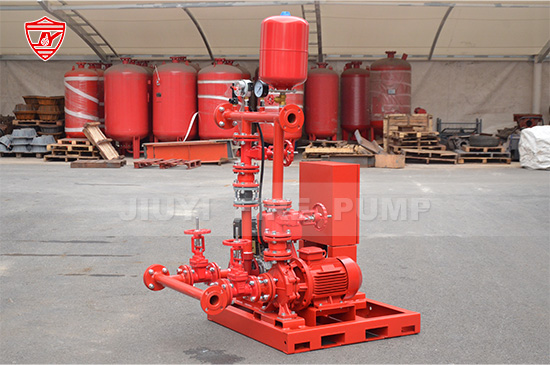
Fire pump head and pressure are closely related but fundamentally different concepts. Head represents the energy added to water by the pump. Pressure represents the force exerted within the system.
In fire protection engineering:
Head defines pump performance.
Pressure defines system operation.
Total Dynamic Head determines proper pump selection.
Hydraulic calculations ensure compliance and safety.
A clear understanding of these principles leads to better system design, safer buildings, and reliable fire protection performance.
For engineers, contractors, and facility owners, mastering the difference between fire pump head and pressure is not just a theoretical exercise—it is a practical necessity for building systems that protect lives and property when it matters most.