Fire pumps are a critical part of many fire protection systems. When a fire emergency occurs, the pump must deliver the required flow and pressure to sprinklers, hydrants, standpipes, or other firefighting equipment. A fire pump that has not been properly maintained may fail to start, deliver insufficient pressure, or operate unreliably when it is needed most.
For building owners, facility managers, fire protection contractors, engineers, and system operators, regular fire pump maintenance is therefore not simply a routine task. It is an essential part of maintaining the performance and reliability of the entire fire protection system.
This guide explains the key principles of fire pump maintenance, including inspection, testing, preventive maintenance, common problems, and practical maintenance considerations for electric and diesel fire pumps.
.jpg)
A fire pump may remain unused for long periods because it is an emergency protection device. However, periods of inactivity do not mean that the equipment is free from risk.
Electrical components can deteriorate, batteries can lose capacity, fuel systems can develop problems, valves can become difficult to operate, and mechanical components can experience wear or corrosion. Even a relatively new fire pump can develop operational problems if installation conditions, environmental factors, or maintenance practices are not properly controlled.
Regular maintenance helps identify potential problems before an emergency occurs. It also provides an opportunity to verify that the pump, driver, controller, valves, and associated components can operate together as intended.
Effective maintenance should focus on three areas:
Fire pump maintenance is more than simply starting the pump periodically. A complete maintenance program normally involves visual inspections, operational testing, mechanical checks, electrical inspections, and documentation.
The exact requirements depend on the type of fire pump, driver, installation, local regulations, and applicable fire protection standards. Maintenance personnel should always follow the applicable requirements for the specific installation.
Typical maintenance activities include checking:
The objective is to confirm that the complete fire pump system remains ready for service.
Routine inspection is one of the simplest ways to identify potential problems.
The fire pump room should be clean, accessible, adequately ventilated, and maintained at suitable environmental conditions. Equipment should be free from excessive corrosion, water accumulation, contamination, or physical damage.
The pump itself should be visually inspected for signs of leakage, unusual corrosion, damaged components, loose connections, or abnormal conditions.
Valves are particularly important. Suction and discharge valves should be in their required operating positions and should remain accessible. A partially closed valve can significantly affect pump performance.
Pressure gauges should also be checked for abnormal readings or visible damage. A sudden change from normal pressure readings can indicate a problem with the pump, water supply, valves, or system.
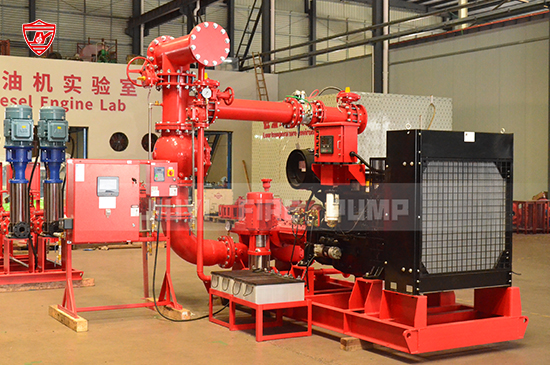
For electric fire pumps, inspect the controller, electrical connections, power supply, and associated components.
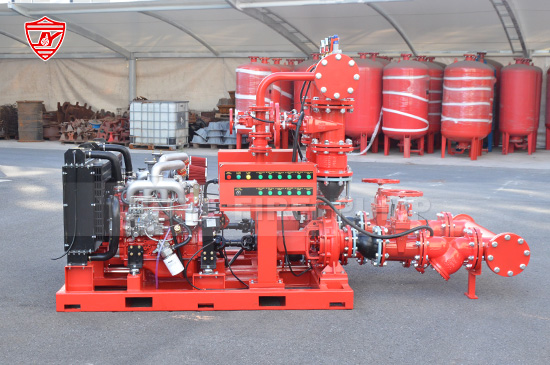
For diesel fire pumps, additional attention should be given to fuel level, batteries, engine oil, coolant, exhaust, ventilation, and other engine-related components.
Inspection alone cannot confirm that a fire pump will perform correctly under operating conditions. Testing is necessary to verify operational performance.
During a fire pump test, key operating parameters can be monitored and compared with expected performance. These may include suction pressure, discharge pressure, flow rate, driver speed, and other relevant operating conditions.
Performance testing can help identify problems such as:
A fire pump may start successfully but still fail to deliver the required performance. This is why operational testing and performance verification are important parts of a comprehensive maintenance program.
For projects with specific certification or approval requirements, maintenance and testing should also be consistent with the applicable certification requirements and project specifications.
Electric fire pumps are widely used because electric motors can provide reliable and straightforward operation when an appropriate power supply is available.
Maintenance of an electric fire pump system should include inspection of both the pump and motor.
The motor should be checked for unusual noise, vibration, overheating, contamination, and other abnormal conditions. Electrical connections should be inspected for looseness, damage, or signs of overheating.
The controller is another critical component. Its indicators, switches, alarms, and starting functions should be checked according to the applicable maintenance procedure.
The electrical power supply should also be reliable. A fire pump cannot perform correctly if the motor does not receive the required electrical power.
During testing, operators should pay attention to motor starting behavior and operating conditions. Abnormal starting current, excessive vibration, unusual noise, or overheating may indicate a developing problem that requires further investigation.
Diesel fire pumps require additional maintenance because the diesel engine contains more mechanical and fluid systems than an electric motor.
Important maintenance areas include:
Engine oil: Check oil level and condition and follow the engine manufacturer's requirements for oil changes.
Fuel system: Ensure that sufficient clean fuel is available and inspect the fuel tank, lines, filters, and connections for leakage or contamination.
Cooling system: Check coolant level and inspect the cooling system for leaks or other abnormal conditions.
Batteries: Battery condition is especially important because the engine must start reliably when required. Battery terminals, charging equipment, connections, and battery condition should be checked regularly.
Exhaust system: Inspect exhaust components for damage, leakage, or other conditions that could affect safe operation.
Ventilation: The pump room must provide appropriate ventilation for the diesel engine and the operating environment.
Diesel fire pump maintenance should always follow the requirements of the specific engine manufacturer as well as applicable fire protection requirements.
The jockey pump plays an important supporting role in a fire protection system. Its purpose is generally to maintain system pressure and compensate for small pressure losses so that the main fire pump does not need to start unnecessarily.
A poorly maintained jockey pump can cause frequent starting of the main fire pump or create unstable system pressure.
Maintenance should include inspection of the jockey pump, motor, controller, pressure settings, valves, and associated piping. Operators should also investigate unusual cycling or frequent starting because these conditions may indicate leakage or another system problem.
Although a jockey pump is smaller than the main fire pump, it should not be overlooked during routine maintenance.
Regular maintenance can help identify common problems before they become serious.
Possible causes may include electrical power problems, controller issues, incorrect valve positions, battery problems, engine starting system faults, or control circuit problems.
The correct troubleshooting process should begin with basic operating conditions and then move toward individual components.
This condition may be related to water supply, suction restrictions, valve position, pump condition, incorrect rotation, system demand, or other factors.
Comparing current operating data with previous test results can help identify changes in performance.
Excessive vibration may indicate alignment problems, bearing wear, coupling issues, hydraulic conditions, foundation problems, or other mechanical conditions.
Vibration should not simply be ignored because continued operation under abnormal conditions may cause additional damage.
Some leakage conditions may be normal depending on the pump design, while excessive leakage may indicate worn seals, damaged components, loose connections, or other problems. The acceptable condition should be evaluated according to the pump design and applicable requirements.
Common areas to investigate include batteries, fuel supply, fuel quality, starting equipment, electrical connections, engine controls, and environmental conditions.
Because reliable engine starting is essential, repeated starting problems should be investigated rather than treated as an occasional inconvenience.
Reactive maintenance means repairing equipment after a problem has already occurred. Although some failures cannot be predicted, relying entirely on reactive maintenance creates additional risk for fire protection equipment.
Preventive maintenance takes a different approach. Equipment is inspected, tested, and maintained at planned intervals to reduce the possibility of unexpected failure.
A practical preventive maintenance program should include:
Historical test records are particularly useful. If pump pressure, flow, vibration, or starting behavior changes gradually over time, the trend may reveal a developing problem before the equipment reaches a critical condition.
A maintenance checklist helps ensure that important tasks are not overlooked.
A useful checklist can be divided into several sections.
Pump: Check for leakage, corrosion, unusual noise, vibration, lubrication, coupling condition, and general mechanical condition.
Driver: Check motor or diesel engine operating condition, connections, temperature, vibration, and other relevant parameters.
Controller: Check indicators, alarms, switches, starting functions, and electrical condition.
Water supply: Check suction conditions, valves, pressure, and other relevant components.
Diesel system: Check fuel, oil, coolant, batteries, charging system, ventilation, and exhaust.
Jockey pump: Check pressure maintenance, starting and stopping behavior, and general condition.
Testing: Record flow, pressure, driver speed, and other relevant performance data.
Documentation: Record inspection dates, test results, maintenance work, abnormal findings, and corrective actions.
The checklist should be adapted to the specific fire pump installation rather than treated as a universal replacement for the manufacturer's instructions or applicable standards.
There is no single maintenance interval that applies to every fire pump installation.
The appropriate schedule depends on the pump type, driver, system design, operating environment, manufacturer's recommendations, applicable fire protection standards, and local requirements.
For this reason, maintenance planning should combine the manufacturer's instructions with the requirements applicable to the specific project.
The most important principle is consistency. Fire pump maintenance should be planned rather than performed only after a problem appears.
Maintenance begins before the fire pump is installed.
When selecting a fire pump, project owners and engineers should consider not only rated flow and pressure but also accessibility, serviceability, component quality, testing capability, driver type, spare parts availability, and long-term operating conditions.
A well-designed fire pump system should allow technicians to inspect and service important components efficiently.
For manufacturers, quality control during production is equally important. Pump hydraulic performance, motor or engine compatibility, assembly accuracy, testing procedures, and final inspection all contribute to long-term reliability.
Factory testing can also help identify manufacturing or assembly problems before equipment is delivered to the project site.
.jpg)
A fire pump is an emergency protection device, but reliability is not created by the pump alone. It depends on proper selection, correct installation, commissioning, regular inspection, testing, maintenance, and documentation.
For facility owners and fire protection professionals, a consistent maintenance program provides an important layer of protection against unexpected equipment problems.
For fire pump manufacturers, the goal is to provide equipment that can deliver dependable performance while also supporting practical inspection, testing, and maintenance throughout its service life.
Whether the installation uses an electric fire pump, diesel fire pump, jockey pump, vertical turbine fire pump, split-case fire pump, or another configuration, maintenance should always be treated as an essential part of the overall fire protection strategy.
A fire pump may remain unused for months or years, but when a fire emergency occurs, there is no opportunity to discover that maintenance was overlooked. Regular inspection, testing, preventive maintenance, and accurate records help ensure that the system remains prepared when reliable fire protection is needed most.