
Fire pump inspection before shipment is a critical quality control process performed by a manufacturer before a fire pump or fire pump system leaves the factory. It is designed to verify that the equipment has been manufactured, assembled, tested, and prepared according to the approved technical requirements.
For fire safety equipment, quality cannot be judged by appearance alone. A fire pump must deliver the required flow and pressure when the system needs it most. Problems involving assembly, materials, alignment, electrical components, control systems, or hydraulic performance can affect the reliability of the complete fire protection system.
A professional pre-shipment inspection therefore provides an important final opportunity to identify and correct potential problems before the equipment is delivered to the project site.
For contractors, distributors, EPC companies, consultants, and facility owners, understanding the fire pump inspection process can help them evaluate manufacturers more effectively and reduce the risk of installation delays, commissioning problems, and unexpected equipment failures.
.jpg)
Fire pumps are often installed as a critical part of fire protection systems in commercial buildings, industrial facilities, warehouses, data centers, factories, and other high-risk environments. Once a pump has been transported to the project site, correcting manufacturing or assembly problems can become more expensive and time-consuming.
A thorough factory inspection helps confirm several important points.
First, it verifies that the supplied product matches the approved specification. Pump model, flow rate, pressure, motor or diesel engine power, connection size, materials, accessories, and other parameters should correspond with the project requirements.
Second, it provides an opportunity to verify hydraulic performance under controlled factory conditions. Flow and pressure measurements can be compared with the required operating point and applicable technical requirements.
Third, it helps identify manufacturing or assembly problems before shipment. Issues such as incorrect wiring, loose connections, improper alignment, leakage, abnormal vibration, or incorrect component installation can be addressed at the factory.
Finally, inspection records provide valuable quality documentation. These records can support project acceptance, traceability, commissioning, and future maintenance.
The exact inspection procedure depends on the pump type, project specifications, applicable standards, certification requirements, and customer requirements. However, a professional fire pump manufacturer normally considers several major inspection areas.
The first step is confirming that the finished product corresponds with the approved order and technical documentation.
Inspectors may verify:
This step is particularly important for customized fire pump packages. A technically well-manufactured pump can still cause project problems if the delivered configuration does not match the approved specification.
A visual inspection evaluates the physical condition and assembly quality of the equipment.
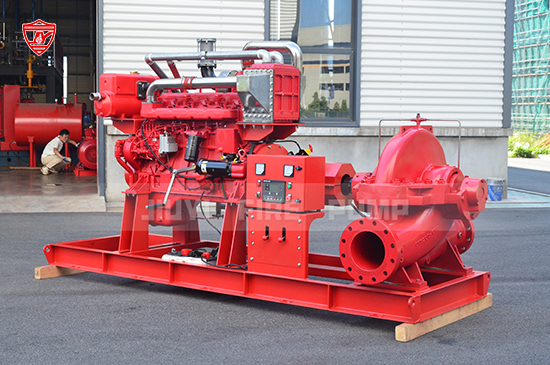
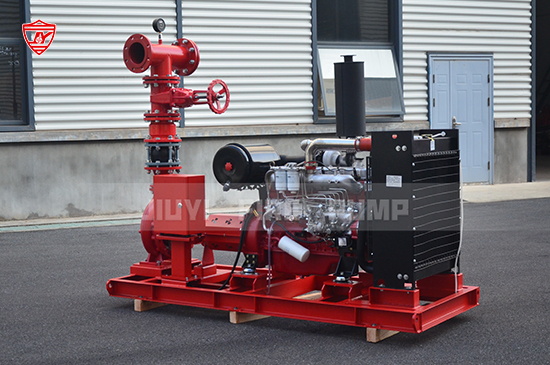
The inspector may examine the pump casing, base frame, coupling, guards, valves, piping, control panel, motor, diesel engine, fuel system, and other components.
The inspection should look for signs of damage, poor finishing, incorrect assembly, missing components, or other abnormalities.
Fasteners should be properly installed, protective guards should be securely fitted, and components should be positioned according to the approved design.
For painted equipment, the surface condition and coating should also be checked to identify obvious defects that could affect corrosion protection or product appearance.
Proper alignment between the pump and driver is essential for reliable operation.
For an electric fire pump, the pump and motor must be correctly aligned. For a diesel-driven fire pump, the alignment between the pump and diesel engine is equally important.
Incorrect alignment can contribute to excessive vibration, bearing problems, coupling wear, seal damage, and reduced equipment life.
Factory inspection should therefore include verification of the coupling, shaft alignment, base installation, and related components according to the manufacturer's procedures and applicable requirements.
For electric fire pumps, electrical inspection is an important part of the pre-shipment process.
The inspection may include verification of:
The purpose is to confirm that the electrical components have been assembled and configured correctly before the equipment reaches the installation site.
For a complete fire pump package, the relationship between the fire pump controller, motor, pressure sensing equipment, and other system components should also be checked.
Diesel fire pump packages require additional inspection because the driver includes more mechanical and auxiliary systems.
A pre-shipment inspection may cover the diesel engine, fuel tank, batteries, starting system, exhaust system, cooling system, lubrication system, instrumentation, and control functions.
The engine should be checked for proper starting and stable operation. Important operating parameters should be monitored during testing.
Fuel connections, battery connections, exhaust components, and other auxiliary systems should also be examined to reduce the possibility of installation or commissioning problems.
Hydraulic performance testing is one of the most important parts of fire pump inspection before shipment.
During a factory performance test, the pump is operated under controlled conditions while flow and pressure are measured.
Depending on the test requirements, the manufacturer may evaluate the pump at several operating points, such as shutoff, rated flow, and other specified flow conditions.
The test results can then be compared with the approved performance requirements.
For example, a fire pump specified to provide a particular flow at a particular pressure should demonstrate that performance during testing. The test data can help confirm that the hydraulic design, impeller, casing, driver, and assembly are working together as intended.
Professional testing equipment is particularly valuable because accurate measurement is essential for meaningful performance verification.
A Factory Acceptance Test, commonly referred to as a FAT, is a formal inspection and testing process performed at the manufacturer's facility before the equipment is shipped.
The exact scope of a FAT is determined by the project requirements and contractual specifications.
For a fire pump package, the FAT may include visual inspection, dimensional verification, component inspection, operational testing, hydraulic performance testing, electrical testing, controller testing, and review of documentation.
Customers or third-party inspectors may also participate in the factory inspection when required.
A well-organized FAT allows project stakeholders to verify the equipment under factory conditions instead of waiting until installation is completed.
This can significantly reduce the risk of discovering major issues during commissioning.
For UL Listed fire pump products, inspection and testing requirements are closely associated with the applicable certification and product requirements.
Manufacturers producing certified fire pumps need to maintain controlled manufacturing processes and quality procedures. Components, construction, performance, labeling, and testing must comply with the applicable requirements for the certified product.
Before shipment, the manufacturer should also verify that the actual product configuration corresponds with the approved and certified design.
For customers purchasing UL Listed fire pumps, it is important to distinguish between simply claiming compliance and having an appropriate certification for the specific product.
The certification status, model, product configuration, and applicable documentation should be carefully verified during procurement and inspection.
Inspection is not limited to the physical equipment. Documentation is another important part of pre-shipment quality control.
Depending on the project, documentation may include:
Documentation should be consistent with the actual equipment being shipped.
This is especially important for international projects, where documents may be required for customs clearance, project approval, installation, commissioning, or final acceptance.
Customers and project inspectors should focus on both product quality and the manufacturer's testing capability.
A professional manufacturer should be able to clearly explain how the pump is inspected, what parameters are tested, how test data is recorded, and how nonconforming products are handled.
Customers can also ask whether the manufacturer has dedicated pump testing equipment and whether the test facility can accommodate the required pump capacity.
For larger fire pump projects, it is useful to review the complete package rather than inspecting the pump alone. The driver, controller, valves, base frame, accessories, and other components all contribute to the reliability of the final system.
Another important consideration is traceability. Product identification, test records, component information, and inspection documentation should be properly controlled.
A fire pump that passes factory inspection is not automatically guaranteed to perform perfectly after installation. Site conditions, installation quality, electrical supply, piping configuration, maintenance, and commissioning procedures also affect system performance.
However, factory inspection significantly reduces one major category of risk: manufacturing and assembly defects.
Detecting problems before shipment is generally easier than identifying them after the equipment has been transported, installed, connected to site piping, and prepared for commissioning.
Pre-shipment inspection can therefore help reduce:
For international fire protection projects, this benefit can be particularly important because returning or repairing large equipment after delivery may involve significant transportation costs and project delays.
A reliable fire pump manufacturer should have more than production capacity. Quality assurance should cover the entire manufacturing process, from engineering and component selection to assembly, testing, documentation, and shipment.
Testing capability is particularly important.
A manufacturer with professional pump testing facilities can verify hydraulic performance under controlled conditions. Advanced testing equipment can also provide more reliable and traceable measurement data.
For projects requiring certified fire pumps, manufacturers should also have appropriate certification experience and established quality control procedures.
At the same time, customers should evaluate whether the manufacturer can provide complete technical documentation and after-sales technical support.
The goal is not simply to purchase a pump. The goal is to obtain a fire pump package that can reliably perform its intended function as part of the overall fire protection system.
.jpg)
Fire pump inspection before shipment is an essential final quality control stage between manufacturing and project installation.
It combines specification verification, visual inspection, assembly checks, alignment verification, electrical or diesel engine inspection, hydraulic performance testing, documentation review, and packaging inspection.
For customers, distributors, EPC contractors, and fire protection professionals, understanding this process provides a practical way to evaluate the quality and reliability of a fire pump supplier.
For manufacturers, a rigorous pre-shipment inspection process demonstrates that product quality is not based solely on production procedures but is verified through measurable testing and documented inspection.
Quality control is integrated into the manufacturing and testing process for fire pump products. With dedicated pump testing capabilities and experience in fire protection equipment manufacturing, the company focuses on verifying product performance and quality before equipment is delivered to customers.
A properly inspected fire pump provides a stronger foundation for successful installation, commissioning, and long-term fire protection system reliability.
.jpg)