Fire pumps are among the most critical components in a fire protection system. When a fire occurs, the pump must start instantly and operate reliably under extreme conditions. While factors such as pump selection, materials, and controller performance receive significant attention, one technical detail is often underestimated during installation and maintenance: fire pump alignment tolerances.
Improper alignment between the pump and its driver is one of the leading causes of vibration, seal failure, bearing damage, and premature pump failure. For fire pumps—where failure is not an option—alignment accuracy is not just a mechanical concern but a life safety issue.
This article explains what fire pump alignment tolerances are, why they matter, what standards expect, and how proper alignment contributes to long-term system reliability.
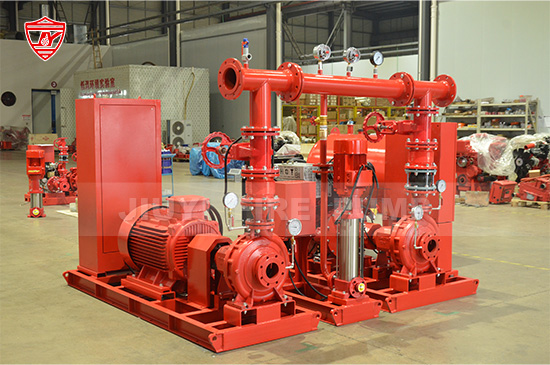
Fire pump alignment refers to the precise positioning of the pump shaft relative to the driver shaft (electric motor or diesel engine) so that both rotate on the same centerline during operation.
Most fire pumps use a flexible coupling between the pump and driver. While flexible couplings can accommodate small amounts of misalignment, they are not designed to correct poor installation. Excessive misalignment places abnormal loads on bearings, seals, shafts, and couplings.
There are two main types of alignment that must be controlled:
Angular alignment: The shafts are at an angle relative to each other.
Parallel (offset) alignment: The shafts are parallel but not on the same centerline.
Proper fire pump alignment requires both conditions to be within acceptable tolerances.
Unlike general industrial pumps, fire pumps operate under specific conditions that make alignment even more critical.
First, fire pumps may sit idle for long periods and then suddenly start at full speed during an emergency. Any misalignment that has slowly stressed components over time can result in immediate failure during startup.
Second, fire pumps are often installed in rigid piping systems with limited flexibility. Thermal expansion, pipe strain, and foundation settlement can all affect alignment after installation.
Third, fire pumps are expected to comply with fire protection standards and pass acceptance testing. Excessive vibration or coupling wear caused by misalignment can lead to test failures, project delays, and costly rework.
Maintaining proper alignment tolerances reduces these risks and ensures reliable performance throughout the pump’s service life.
Alignment tolerances vary depending on pump size, speed, coupling type, and manufacturer recommendations. However, industry best practices generally follow these guidelines for horizontal fire pumps:
Parallel (offset) misalignment: typically within 0.05 mm to 0.10 mm
Angular misalignment: typically within 0.2 mm per 100 mm of coupling diameter
For vertical turbine fire pumps, alignment focuses more on concentricity, straightness of the column, and motor-to-head alignment rather than coupling alignment, but tolerances are equally strict.
It is important to understand that these values are general guidance. The final allowable tolerances should always follow:
Pump manufacturer recommendations
Coupling manufacturer limits
Project specifications
Ignoring these limits can void warranties and compromise system performance.
NFPA 20 does not publish specific numeric alignment tolerances. Instead, it places responsibility on proper installation and manufacturer instructions.
NFPA 20 requires that:
Fire pumps be installed in accordance with manufacturer recommendations
Equipment be installed to minimize vibration and mechanical stress
The pump and driver operate smoothly during acceptance testing
This means that alignment is implicitly required to meet NFPA 20 performance expectations. If misalignment causes excessive vibration, noise, or component wear, the installation may be considered non-compliant even if exact tolerance values are not stated.
From a practical standpoint, AHJs, inspectors, and commissioning engineers expect professional alignment practices consistent with accepted mechanical standards.
Even when alignment is performed during installation, several factors can cause misalignment over time.
One common cause is soft foot. This occurs when one or more motor or pump feet do not sit flat on the baseplate, causing distortion when bolts are tightened. Soft foot can throw alignment out of tolerance even if initial measurements appear correct.
Another cause is pipe strain. Fire pump suction and discharge piping must be properly supported and aligned. Excessive piping force can pull the pump out of alignment after installation.
Foundation settlement is also a concern, particularly in large pump rooms or retrofitted buildings. Small changes in baseplate level can significantly affect alignment.
For diesel engine fire pumps, thermal growth plays a major role. Engines and pumps expand differently as temperatures rise, and alignment must account for operating conditions, not just cold alignment.
Several methods are used to align fire pumps, ranging from basic to advanced.
Straightedge and feeler gauge methods are still used in some installations, but they rely heavily on technician experience and are less accurate for high-speed fire pumps.
Dial indicator alignment provides more precision and allows measurement of both angular and parallel misalignment. This method has been widely accepted for fire pump installations.
Laser alignment systems are increasingly common and offer the highest accuracy. They are especially useful for large pumps, tight tolerances, and diesel-driven fire pumps where thermal growth calculations are required.
Regardless of the method used, alignment should always be verified after:
Final piping connection
Grouting and curing
Initial test run
Horizontal Split Case Fire Pumps
These pumps are sensitive to baseplate flatness and pipe strain. Alignment should be checked multiple times during installation, especially after grouting.
End Suction Fire Pumps
Compact designs can hide misalignment issues. Careful soft foot correction and coupling alignment are essential.
Vertical Turbine Fire Pumps
Alignment focuses on the vertical shaft, column straightness, and motor alignment. Any deviation can cause shaft vibration, bowl wear, and reduced efficiency.
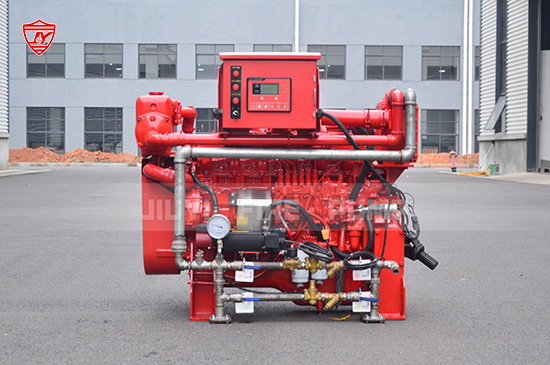
Diesel Engine Fire Pumps
These require special attention to hot alignment conditions. Alignment performed only at ambient temperature may be incorrect during operation.
The impact of improper alignment is not always immediate, which makes it particularly dangerous.
Short-term effects include:
Increased vibration
Abnormal noise
Coupling overheating
Long-term consequences are more severe:
Bearing failure
Mechanical seal leakage
Shaft fatigue and cracking
Reduced pump efficiency
Unexpected failure during a fire event
From a fire safety perspective, any of these outcomes represent unacceptable risk.
Alignment is not a one-time task. To ensure long-term reliability, fire pump alignment should be part of a structured maintenance program.
Recommended practices include:
Verifying alignment during annual fire pump testing
Rechecking alignment after any major maintenance or piping work
Monitoring vibration trends for early signs of misalignment
Maintaining detailed installation and alignment records
As a manufacturer, we strongly recommend working with qualified technicians who understand fire pump-specific requirements rather than general industrial alignment alone.
Fire pump manufacturers design equipment to operate within defined mechanical limits. Alignment tolerances are not arbitrary; they are based on bearing loads, shaft dynamics, and long-term reliability testing.
When alignment tolerances are respected:
Pumps operate smoothly
Service life is extended
Maintenance costs are reduced
Fire protection systems remain dependable
From our experience, many early fire pump failures are not due to design flaws, but to installation and alignment issues that could have been avoided.
Fire pump alignment tolerances may seem like a small technical detail, but their impact on system reliability is significant. Proper alignment protects critical components, ensures compliance with fire protection expectations, and most importantly, helps guarantee that the fire pump will perform when it is needed most.
For engineers, contractors, and facility owners, understanding and respecting alignment tolerances is an essential part of responsible fire pump installation and maintenance. For manufacturers, it is a key factor in delivering the performance and reliability that fire safety demands.
.jpg)