Fire protection systems are only as reliable as their water supply. In many industrial facilities, power plants, refineries, mines, and remote installations, the available water source is not a ground-level tank or municipal line, but a deep well, river basin, or underground reservoir. In these conditions, conventional fire pumps cannot operate effectively. This is where vertical turbine fire pumps become essential.
Vertical turbine fire pumps are specifically engineered to deliver stable, high-pressure water from deep or low-level sources where other pump types fail. Their unique construction allows them to meet fire protection demands while complying with international standards such as NFPA 20. Understanding why vertical turbine fire pumps are used for deep wells is critical for fire protection engineers, system designers, and project owners.
The Challenge of Deep Well Water Sources in Fire Protection
Fire pump selection always begins with the water source. Unlike domestic or booster pump systems, fire pumps must deliver full rated flow and pressure instantly and reliably under emergency conditions.
Deep wells present several challenges:
-
Water level is far below ground surface
-
Suction lift exceeds the limits of end suction or split case pumps
-
Water levels may fluctuate seasonally
-
Cavitation risk increases at low suction pressure
-
Limited space may restrict pump installation options
Traditional horizontal fire pumps rely on flooded suction conditions. When water levels are too low, these pumps cannot maintain prime, leading to unreliable performance. Fire protection codes do not allow systems that depend on manual priming or uncertain suction conditions.
Vertical turbine fire pumps solve these problems by placing the pumping elements directly inside the water source.
What Is a Vertical Turbine Fire Pump?
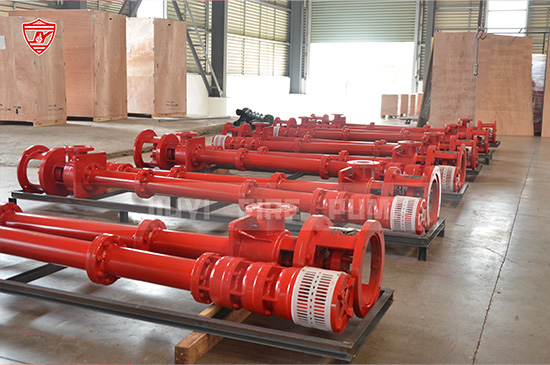
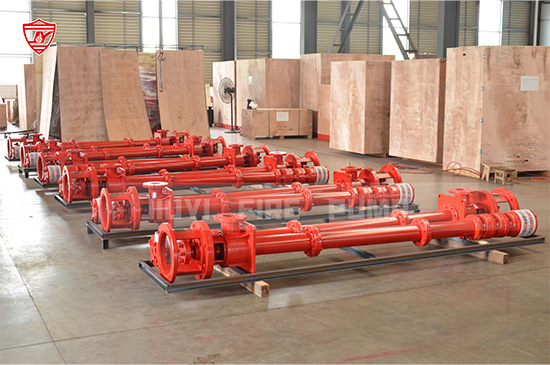
A vertical turbine fire pump is a centrifugal pump designed with multiple impellers mounted on a vertical shaft. The pump bowl assembly is submerged below the water level, while the driver (electric motor or diesel engine) is installed at ground level.
Water enters through a suction bell at the bottom of the pump, passes through staged impellers that increase pressure, and is discharged upward through a vertical column pipe to the fire protection system.
This configuration makes vertical turbine fire pumps uniquely suitable for deep wells, open water sources, and underground reservoirs.
How Vertical Turbine Fire Pumps Work in Deep Wells
The working principle of a vertical turbine fire pump is based on submerged pumping rather than suction lift.
Key operating characteristics include:
-
The pump bowls are always submerged, eliminating suction lift limitations
-
Impellers are staged to generate required fire pressure
-
The vertical shaft transmits torque from the driver to the impellers
-
Water is lifted through column pipes without loss of prime
Because the pumping components are located below the minimum water level, the pump does not rely on atmospheric pressure to draw water upward. This allows stable operation even when water levels are extremely low.
Key Reasons Vertical Turbine Fire Pumps Are Used for Deep Wells
Ability to Handle Extremely Low Water Levels
The most important reason vertical turbine fire pumps are used for deep wells is their ability to operate with very low water levels.
As long as the pump bowls remain submerged, the system can function normally. This makes them ideal for:
-
Deep groundwater wells
-
Underground storage reservoirs
-
Rivers, canals, and lakes with fluctuating levels
-
Fire water sumps located far below grade
No other fire pump type can reliably operate under these conditions.
Elimination of Suction Lift Limitations
End suction and horizontal split case fire pumps are limited by suction lift, typically no more than a few meters under ideal conditions. Deep wells far exceed these limits.
Vertical turbine fire pumps eliminate suction lift entirely by placing the pumping stages below the water surface. This ensures compliance with fire protection requirements and removes the risk of air ingress or loss of prime.
Stable Performance Under Emergency Conditions
Fire protection systems must perform immediately and consistently during emergencies. Any delay or instability can result in catastrophic consequences.
Vertical turbine fire pumps provide:
-
Immediate water delivery upon start
-
Stable flow and pressure across the operating range
-
Reduced risk of cavitation
-
Consistent performance regardless of water depth
This reliability is one of the primary reasons they are specified in critical facilities.
Compliance with NFPA 20 Requirements
NFPA 20 recognizes vertical turbine fire pumps as the correct solution when the water source is located below the pump installation.
When designed and installed properly, vertical turbine fire pumps meet all fire protection requirements, including:
-
Rated flow and pressure
-
Continuous duty operation
-
Automatic start under fire conditions
-
Mechanical integrity and durability
For deep well applications, NFPA 20 often leaves no alternative pump type.
Adaptability to Different Water Sources
Vertical turbine fire pumps are not limited to drilled wells. They can be adapted for a wide range of water sources, including:
-
Open basins
-
Raw water intake structures
-
Cooling water pits
-
Underground fire water tanks
This flexibility makes them a preferred solution in industrial and infrastructure projects.
Design Features That Make Vertical Turbine Fire Pumps Ideal
Multi-Stage Impeller Design
Deep wells often require high discharge pressure to overcome elevation and system losses. Vertical turbine fire pumps use multiple impeller stages to generate the required pressure without excessive speed or energy loss.
This staged design allows precise matching of pump performance to system demands.
Column Pipe and Line Shaft Construction
The column pipe not only transports water but also houses the line shaft that connects the driver to the impellers. This vertical configuration supports long shaft lengths, making it possible to reach significant depths without performance loss.
Special bearings and lubrication systems ensure smooth operation even at extended lengths.
Submerged Pump Bowls
Because the pump bowls are submerged, issues such as air binding, vapor pockets, and suction instability are minimized. This is critical for fire protection systems that must operate under unpredictable conditions.
Compatibility with Electric and Diesel Drivers
Vertical turbine fire pumps can be driven by electric motors or diesel engines, allowing system designers to meet redundancy and power supply requirements.
This flexibility is especially important in remote locations where utility power may be unreliable.
Typical Applications Requiring Vertical Turbine Fire Pumps
Vertical turbine fire pumps are commonly used in:
-
Power generation plants
-
Oil and gas facilities
-
Mining operations
-
Petrochemical complexes
-
Large industrial parks
-
Coastal and port installations
-
Data centers with underground water storage
In many of these applications, deep wells are the only viable water source for fire protection.
Installation Considerations for Deep Well Fire Pumps
While vertical turbine fire pumps offer clear advantages, proper installation is critical.
Key considerations include:
-
Accurate determination of minimum water level
-
Correct setting depth for pump bowls
-
Alignment of column pipes and shaft
-
Proper thrust bearing selection
-
Adequate access for inspection and maintenance
Experienced manufacturers and installers play a vital role in ensuring long-term reliability.
Maintenance and Long-Term Reliability
One concern sometimes raised about vertical turbine fire pumps is maintenance. However, when properly designed, they offer excellent long-term reliability.
Routine inspection typically focuses on:
-
Driver condition
-
Thrust bearing performance
-
Shaft alignment
-
Vibration monitoring
Because the pump bowls are submerged and protected from external contamination, wear can be lower than expected in many environments.
Comparison with Other Fire Pump Types
When evaluating fire pumps for deep well applications, vertical turbine fire pumps stand apart.
-
End suction fire pumps require flooded suction and cannot handle deep wells
-
Horizontal split case fire pumps also depend on positive suction pressure
-
Submersible pumps may lack fire protection certification or required performance
Vertical turbine fire pumps are purpose-built for fire protection and deep water sources, making them the most reliable and code-compliant option.
Why Manufacturers Recommend Vertical Turbine Fire Pumps for Deep Wells
From a manufacturer’s perspective, vertical turbine fire pumps provide a proven, standardized solution for challenging water sources. Their design aligns with fire protection codes, engineering best practices, and real-world operating conditions.
They reduce system risk, improve reliability, and ensure that fire protection systems perform exactly when they are needed most.
Conclusion
Vertical turbine fire pumps are used for deep wells because no other fire pump type can match their ability to deliver reliable, high-pressure water from low-level or underground sources. Their submerged design, staged impellers, and vertical construction eliminate suction limitations and ensure stable performance under emergency conditions.
For facilities relying on deep wells, underground reservoirs, or fluctuating water sources, vertical turbine fire pumps are not just an option—they are a necessity. Selecting the right vertical turbine fire pump is a critical decision that directly impacts fire safety, system compliance, and long-term operational reliability.