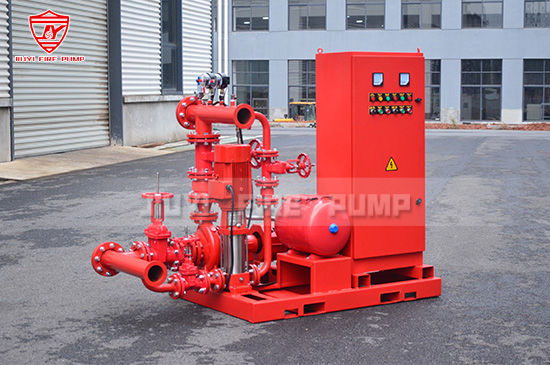
Fire pump factory performance testing verifies that a fire pump can deliver the required flow and pressure before it leaves the manufacturer. Learn how flow, pressure, performance curves, and quality checks help confirm reliable fire pump performance.
.jpg)
Fire pump factory performance testing is the process of evaluating a completed fire pump under controlled conditions at the manufacturer's facility. The purpose is to verify that the pump performs according to its specified design requirements before it is packaged and shipped to the project site.
A fire pump is a critical part of a fire protection system. During an emergency, it must provide sufficient water flow and pressure to support sprinklers, hydrants, standpipes, hose systems, or other firefighting equipment. A pump that does not achieve the required hydraulic performance can affect the effectiveness of the entire fire protection system.
Factory performance testing provides an important opportunity to identify performance problems before installation. Instead of discovering a problem during commissioning, manufacturers can evaluate the pump under controlled test conditions and make necessary adjustments before delivery.
For fire protection contractors, EPC companies, distributors, consultants, and building owners, factory testing provides additional confidence that the equipment supplied is consistent with its specified performance.
Fire pumps are manufactured according to specific flow, pressure, speed, power, and application requirements. Simply assembling the pump correctly does not guarantee that its actual hydraulic performance will match the expected results.
Factory testing helps verify the relationship between flow and pressure and confirms that the pump operates within its intended performance range.
There are several important reasons to conduct fire pump factory performance testing.
First, testing helps verify product quality. The manufacturer can compare actual test results with the required technical specifications.
Second, testing helps identify manufacturing or assembly problems. Issues related to impeller dimensions, internal clearances, rotating components, motor performance, or other factors may affect pump operation.
Third, factory testing provides performance data that can be used for quality records and project documentation.
Finally, testing reduces the risk of unexpected performance issues after the pump arrives at the installation site.
For projects with demanding fire protection requirements, factory testing is especially valuable because the consequences of inadequate pump performance can be significant.
The exact testing program depends on the pump type, project requirements, applicable standards, certification requirements, and manufacturer procedures. However, hydraulic performance is one of the most important areas of evaluation.
Flow rate is a fundamental fire pump performance parameter. It describes how much water the pump can deliver over a specific period, commonly expressed in gallons per minute or cubic meters per hour.
During factory testing, the pump may be evaluated at multiple operating points rather than at only one flow rate. This allows the manufacturer to develop a performance curve and understand how the pump behaves across its operating range.
Testing at different flow conditions is important because a pump's pressure changes as flow increases or decreases.
Discharge pressure is another critical measurement. The pump must be capable of developing the pressure required by the fire protection system at the specified flow.
During testing, pressure is measured at defined operating conditions. The results are then compared with the expected pump performance.
For a fire protection application, the relationship between flow and pressure is particularly important. A pump that provides adequate pressure at low flow but cannot maintain the required pressure at higher flow may not meet the project's hydraulic requirements.
Depending on the pump configuration and testing requirements, suction conditions can also be monitored during the factory test.
Suction pressure and available water supply conditions can influence pump performance. Proper control and measurement of the test system help ensure that the test results can be evaluated correctly.
Pump speed directly affects hydraulic performance. The manufacturer may monitor rotational speed during testing to confirm that the pump operates at the intended rated speed.
For motor-driven and diesel-driven fire pumps, maintaining the appropriate operating speed is essential for achieving the expected flow and pressure.
The pump driver also plays an important role in the overall system.
For an electric fire pump, electrical parameters such as voltage, current, frequency, and motor operating conditions may be monitored according to the applicable testing requirements.
For a diesel fire pump, engine operating conditions and speed are important factors in verifying that the driver can provide the required power under the specified operating conditions.
The pump and driver must work together as a complete system. Hydraulic performance should therefore be considered together with driver capability.
One of the key results of factory performance testing is the fire pump performance curve.
A performance curve typically shows the relationship between pump flow and pressure or head. As flow increases, the pressure produced by the pump generally changes according to the hydraulic characteristics of the specific pump.
During factory testing, measurements are taken at different operating points. These results can then be plotted to establish the actual performance characteristics of the pump.
The performance curve provides valuable information for engineers and fire protection professionals. It helps them understand whether the selected pump can satisfy the hydraulic requirements of the intended fire protection system.
Comparing actual test results with the expected performance curve is also an important part of quality control.
A professional fire pump manufacturer requires a properly designed testing facility to obtain reliable test results.
A typical fire pump test facility may include water storage or supply systems, calibrated flow measurement equipment, pressure measurement instruments, control equipment, piping, valves, and data acquisition systems.
The test system should be capable of providing stable and controlled operating conditions across the required performance range.
Measurement accuracy is also important. Instruments used to measure flow, pressure, speed, voltage, current, and other parameters should be properly maintained and calibrated according to the manufacturer's quality procedures and applicable requirements.
Modern fire pump manufacturers may use intelligent test systems to automatically collect and record test data. Digital data acquisition can improve efficiency, reduce manual recording errors, and make performance results easier to review.
A well-equipped factory testing facility therefore supports not only product testing but also the manufacturer's broader quality management process.
Factory performance testing and field testing serve different purposes.
Factory performance testing is performed before shipment, under controlled conditions at the manufacturer's facility. It focuses on verifying the pump itself and, where applicable, the pump and driver assembly.
Field testing takes place after installation. It evaluates the installed fire pump system under actual site conditions.
Both are important.
Factory testing helps confirm that the manufactured equipment meets the required performance before shipment. Field testing helps verify that the installed equipment, piping, water supply, electrical system, controller, valves, and other components work properly as part of the complete fire protection system.
Factory test results should not therefore be considered a replacement for required field commissioning or acceptance testing.
Instead, the two testing stages complement each other.
The term Factory Acceptance Test, or FAT, is commonly used to describe testing performed at the manufacturer's facility before equipment is delivered.
For fire pump packages, the factory acceptance process may include visual inspection, dimensional checks, component verification, hydraulic performance testing, driver checks, control panel verification, and documentation review, depending on the project requirements.
The exact FAT scope should be agreed upon by the manufacturer, customer, consultant, contractor, or other relevant parties before testing.
For large or technically demanding projects, customers may also participate in or witness factory testing. This allows project representatives to review the equipment and test results before shipment.
A clear FAT procedure can help prevent misunderstandings and ensure that the manufacturer and customer have the same expectations regarding acceptance criteria.
Factory performance testing is not simply a final inspection. It can also contribute to continuous manufacturing quality control.
When test data is collected from multiple pumps, manufacturers can identify performance trends and investigate deviations. This information can support improvements in hydraulic design, casting, machining, assembly, driver selection, and production processes.
For example, if a pump consistently produces less pressure than expected at a particular flow point, engineers can investigate possible causes. These may include hydraulic design characteristics, impeller dimensions, rotational speed, internal clearances, or other manufacturing variables.
Testing therefore creates a feedback loop between product design and manufacturing.
A manufacturer with strong testing capabilities can use this feedback to improve consistency across different production batches.
When purchasing a fire pump, customers should look beyond the basic product specification and ask how the manufacturer verifies performance.
Useful questions include:
What performance points are tested?
How is flow measured?
How is pressure measured?
Are test instruments calibrated?
Can the manufacturer provide performance test data?
Is the pump tested with its intended driver?
What standards and project requirements are used to define the test procedure?
Can factory testing be witnessed by the customer or an authorized representative?
What documentation is provided after testing?
These questions can help customers understand the manufacturer's quality assurance capabilities and determine whether the testing process is appropriate for the project.
A fire pump is not simply another industrial pump. It is a critical component whose performance can directly affect the availability of water for firefighting.
For this reason, reliable manufacturing should include more than material inspection and assembly checks. Performance verification is an important part of demonstrating that the finished pump can achieve its intended hydraulic requirements.
Factory performance testing provides a controlled environment for evaluating the pump before installation. It can help manufacturers identify problems early, support quality documentation, and give customers greater confidence in the equipment they are purchasing.
For fire pump manufacturers, investment in professional testing facilities, measurement systems, engineering expertise, and quality procedures is therefore an important part of delivering dependable fire protection equipment.
As a fire pump manufacturer, BETTER Technology Group places strong emphasis on product performance verification and quality control.
The company operates intelligent pump performance testing equipment and online motor testing systems to support comprehensive product testing. The intelligent pump test equipment covers a wide power range from 0.37 kW to 1000 kW and supports multiple voltage levels, including 200V, 208V, 220V, 380V to 480V, 660V, and 10kV, as well as both 50Hz and 60Hz operating conditions.
The testing capabilities support the performance verification of fire pump products and provide data for product quality evaluation.
For fire pump projects, factory testing is an important step between manufacturing and installation. By verifying hydraulic performance, driver operation, and key technical parameters before shipment, manufacturers can help customers reduce project risks and improve confidence in the equipment.
.jpg)
Fire pump factory performance testing is a critical quality assurance process used to verify pump performance before delivery. By measuring parameters such as flow, pressure, speed, and driver performance, manufacturers can confirm that the finished equipment meets its intended requirements.
A professional factory testing process also provides valuable performance data, supports quality control, and helps identify potential problems before equipment reaches the project site.
For contractors, engineers, distributors, and building owners, understanding how a fire pump is tested at the factory can make it easier to evaluate manufacturers and select reliable fire protection equipment.
.jpg)